That perfect brushed nickel vanity light seems simple enough to find—until you’re faced with hundreds of options. Suddenly, you’re juggling questions about size, shade direction, and glass types, and the “simple” upgrade feels overwhelming. This fixture isn’t just a utility; it’s the centerpiece of your morning and evening routines, capable of transforming a functional space into a personal sanctuary.
Choosing correctly means the difference between a flattering, well-lit reflection and a bathroom that feels harsh or dim. We’ll break down the key decisions so you can select a fixture that looks great and performs flawlessly for years to come.
At a Glance: Your Quick Guide to Success
- Size it Right: Learn the 75% rule for matching your light fixture to your mirror or vanity width.
- Direct the Light: Understand the critical difference between uplighting for ambiance and downlighting for tasks.
- Pick Your Glass: Discover how clear, frosted, and seeded glass shades impact brightness, glare, and style.
- Choose the Perfect Glow: Master the basics of lumens (brightness) and Kelvin (color temperature) to create a flattering environment.
- Avoid Common Pitfalls: Get practical tips on placement and installation to ensure a professional-looking result.
Why Brushed Nickel Endures as the Bathroom Standard
Before we dive into specifics, let’s appreciate why brushed nickel remains a top choice. Unlike the high shine of polished chrome, brushed nickel has a soft, low-sheen finish achieved by treating the metal with a wire brush. This process creates a subtle texture that hides fingerprints and water spots exceptionally well—a major benefit in a high-humidity environment like a bathroom.
Its warm silver tone offers incredible versatility, bridging the gap between cool-toned chromes and warm-toned brass or bronze. This makes it a design chameleon, fitting seamlessly into modern, traditional, transitional, and farmhouse aesthetics. While other finishes trend in and out, brushed nickel provides a timeless foundation. For a comprehensive look at how this finish can unify your entire space, our guide to Brushed nickel bathroom lights offers a broader perspective on coordinating all your fixtures.
The Core Four: Your Framework for a Perfect Choice
Making the right decision comes down to four key factors: Sizing and Placement, Light Direction, Glass Type, and Overall Style. Get these right, and you’re guaranteed a fantastic result.
1. Nail the Sizing and Placement
An improperly sized vanity light can throw off the entire room’s proportions. Too small, and it looks lost; too large, and it overwhelms the space.
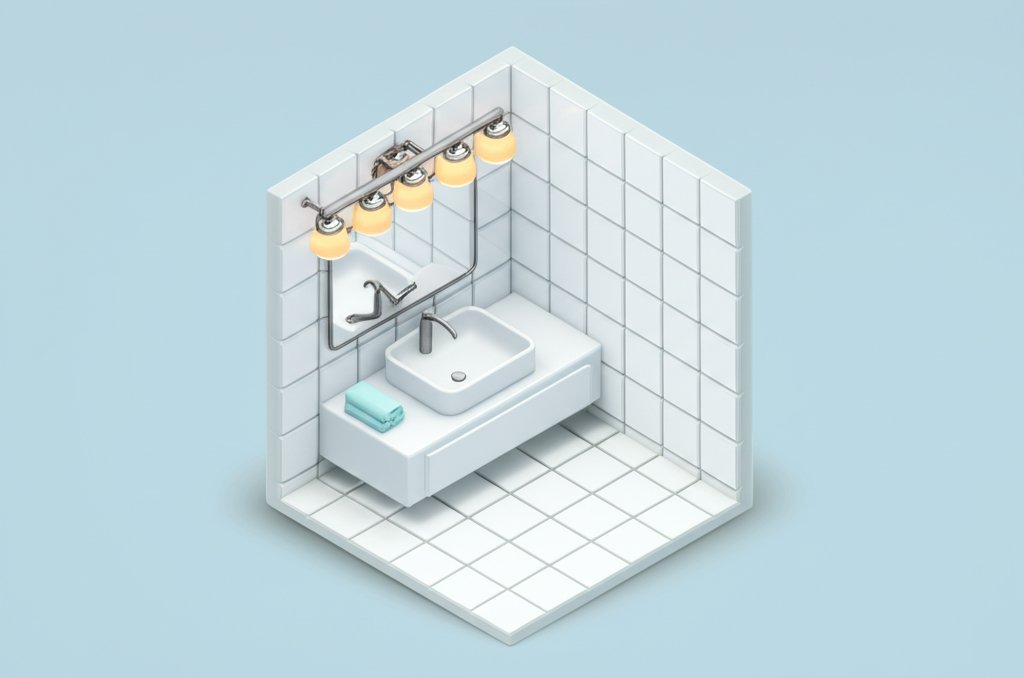
The Golden Rule: Aim for a vanity light that is approximately 75% of the width of your vanity mirror. If you don’t have a framed mirror, use the width of your vanity cabinet as your guide. The fixture should never be wider than the mirror or vanity.
| Vanity Width | Recommended Fixture Width | Typical # of Lights |
|---|---|---|
| 24″ – 30″ | 18″ – 24″ | 2- or 3-light |
| 36″ – 48″ | 27″ – 36″ | 3- or 4-light |
| 60″+ (double vanity) | Two 24″+ fixtures (one over each sink) | Two 2- or 3-light fixtures |
| Placement Snippet: For a single fixture mounted above the mirror, the ideal height is 75 to 80 inches from the floor. This positions the light to illuminate your face evenly without casting harsh shadows. If you have the space, especially with a tall mirror, consider flanking it with two vertical sconces instead. Mount these at roughly eye level (about 66 inches from the floor) and 36 to 40 inches apart. |
2. Uplight vs. Downlight: More Than Just Looks
The direction of the glass shades dramatically changes the light’s function and feel.
- Downlighting (Shades facing down): This is the best choice for task lighting. It directs a focused cone of light onto the countertop and your face, ideal for shaving, applying makeup, or inserting contacts. The downside? It can sometimes create shadows under your eyes if mounted too high. Most modern and functional designs favor downlighting.
- Uplighting (Shades facing up): This style casts light upward, which then bounces off the ceiling to create soft, ambient illumination. It’s excellent for reducing glare and making a space feel larger and more open. While beautiful, it’s not ideal as the sole source of task lighting. It works best in powder rooms or guest baths where ambiance is prioritized over function.
- A practical scenario: In a master bathroom, a 3-light brushed nickel vanity light with downward-facing frosted shades provides excellent, glare-free task lighting. In a small powder room, an uplight fixture with clear, seeded glass can create a dramatic, welcoming glow that makes the space feel more luxurious.
3. Decode the Glass: Clear, Frosted, or Seeded?
The type of glass shade you choose impacts both the aesthetic and the quality of light.
- Clear Glass: Offers maximum brightness and a crisp, clean look. It puts the light bulb on full display, making it a great pairing for vintage-style Edison bulbs. The downside is that it can produce glare and shows dust and fingerprints easily.
- Best for: Farmhouse, industrial, or modern styles where you want a bright, unobstructed light.
- Frosted or Opal Glass: This glass is etched or coated to be translucent, not transparent. It diffuses the light beautifully, creating a soft, even glow with minimal glare. This is the most forgiving and functional option for task lighting, as it hides the bulb and softens shadows.
- Best for: Any style where soft, flattering light is the priority. It’s a workhorse for transitional and contemporary bathrooms.
- Seeded or Hammered Glass: This glass contains tiny bubbles or has a textured surface. It adds a layer of visual interest and character, gently diffusing the light without obscuring it completely. It’s a fantastic compromise between the starkness of clear glass and the opacity of frosted glass, and it does a great job of hiding dust.
- Best for: Transitional, coastal, and rustic designs that benefit from a touch of texture.
4. Matching Your Bathroom’s Aesthetic
Your brushed nickel vanity light should complement your bathroom’s overall design, not compete with it.
- For a Modern or Minimalist Bathroom: Look for fixtures with clean lines, geometric shapes (squares, cylinders), and a simple bar design. Both clear and frosted glass work well here. An integrated LED bar light in brushed nickel is the ultimate minimalist statement.
- For a Farmhouse or Transitional Bathroom: Consider designs with gooseneck arms, clear bell-shaped or mason-jar-style shades, and visible hardware details. Seeded glass is a perfect fit for this style.
- For a Traditional or Classic Bathroom: Opt for fixtures with more ornate details, curved arms, and bell-or-globe-shaped shades. Frosted or opal glass often complements the softer look of traditional design.
Beyond the Fixture: The Bulbs That Make the Light
Your work isn’t done after you choose the fixture. The light bulbs you install are just as important for creating the right atmosphere and functionality.
Lumens, Not Watts: Getting the Brightness Right
Forget thinking in watts; modern lighting is all about lumens. Lumens measure the actual brightness of a bulb. For a vanity area, you need strong, clear light for tasks.
- Expert Recommendation: Aim for a total of 1,600 to 2,400 lumens for a single-sink vanity. For a 3-light fixture, that means choosing three bulbs that are each around 600-800 lumens (the equivalent of a traditional 60-watt incandescent bulb).
The Color Temperature Conundrum (Kelvin Scale)
Color temperature, measured in Kelvin (K), determines whether the light appears warm (yellowish) or cool (bluish). This is crucial for rendering skin tones accurately.
- 2700K (Warm White): Gives off a cozy, yellowish glow similar to old incandescent bulbs. It’s relaxing but can make colors look dull. Best for a spa-like feel or a powder room.
- 3000K (Soft White/Bright White): This is the sweet spot for most bathrooms. It’s a neutral white light that is bright and clean without feeling sterile. It renders colors and skin tones accurately and is flattering.
- 4000K (Cool White): A crisp, blue-toned white light that mimics natural daylight. It’s excellent for precise makeup application but can feel stark or clinical in some settings.
- 5000K+ (Daylight): Very blue and intense. While used in commercial settings, it’s generally too harsh for a home bathroom and can make a space feel cold.
For the most versatile and flattering light, choose dimmable LED bulbs with a color temperature of 3000K.
Quick Answers to Common Questions
Q: Is brushed nickel going out of style in 2024?
A: Absolutely not. While warmer metals like brass and bronze are trending, brushed nickel is considered a timeless classic. It’s a safe, versatile choice that won’t look dated in a few years. It’s the “perfect pair of jeans” for your bathroom—it always works.
Q: Can I mix a brushed nickel vanity light with other metal finishes?
A: Yes, mixing metals is a popular and sophisticated design strategy. The key is to be intentional. A brushed nickel vanity light pairs beautifully with matte black faucets or chrome hardware. A good rule is to stick to two, or at most three, metal finishes in one room to maintain a cohesive look.
Q: How many lights do I need on my vanity fixture?
A: This depends on the width of your vanity. For vanities up to 30 inches, a 2- or 3-light fixture is sufficient. For 36- to 48-inch vanities, a 3- or 4-light fixture provides more even coverage. For double vanities (60 inches or more), using two separate 2- or 3-light fixtures—one centered over each sink—is almost always the best approach for balanced lighting.
Q: What’s the best way to clean a brushed nickel fixture?
A: The beauty of brushed nickel is its low maintenance. Simply wipe it down with a soft, damp microfiber cloth. For stubborn spots, use a mild solution of water and dish soap, then rinse with a clean damp cloth and dry completely to prevent water spots. Avoid abrasive cleaners or harsh chemicals, which can damage the finish.
Your Quick-Start Decision Guide
Feeling ready to choose? Follow this simple path to find the perfect brushed nickel vanity light for your space.
- Measure First: Get the exact width of your vanity mirror or cabinet. Calculate 75% of that width to determine your ideal fixture size.
- Define the Function: Is this a master bath that needs bright, functional task lighting (choose downlights) or a powder room where ambiance is key (consider uplights)?
- Select Your Style: Look at your faucet, towel bars, and cabinet pulls. Choose a fixture with a complementary style—be it modern, farmhouse, or traditional.
- Pick Your Glass: Decide on your tolerance for glare and cleaning. Frosted glass offers the softest, most functional light, while clear and seeded glass provide more character.
- Buy the Right Bulbs: Don’t forget the final step! Purchase dimmable LED bulbs around 800 lumens each with a 3000K color temperature for the best all-around performance.
By focusing on these key decisions, you can confidently select a fixture that not only illuminates your bathroom but enhances its style and functionality for years to come.

- DIY Bathroom Mirror Frame Designs on a Budget - October 12, 2026
- Creative Bathroom Mirror Border Ideas for Every Style and Budget - October 11, 2026
- Bathroom Finishes That Handle Moisture and Look Great - October 10, 2026