The wrong lighting over a bathroom mirror casts harsh, unflattering shadows, making everyday tasks like shaving or applying makeup a frustrating exercise in guesswork. The solution lies in choosing the right vanity led light fixtures, which do more than just illuminate the space—they blend high-performance task lighting with decor-defining style. By understanding how to select and place these fixtures, you can transform your bathroom into a space that is both exceptionally functional and beautifully designed.
At a Glance: Your Quick Guide
- Match Style to Space: Learn to identify which fixture styles—from sleek modern bars to classic traditional sconces—will complement your bathroom’s aesthetic.
- Master Sizing & Placement: Discover the professional rules for positioning fixtures vertically or horizontally to eliminate shadows for perfect task lighting.
- Decode the Tech Specs: Understand what lumens (brightness), Kelvin (color temperature), and CRI (color accuracy) mean for your daily routine.
- Integrated vs. Bulbs: See why integrated LED fixtures offer superior design flexibility and longevity compared to traditional bulb-based lights.
- Create a Layered Look: Realize how your vanity light works with other light sources to create a balanced, spa-like atmosphere.
Why Integrated LEDs Are a Smarter Choice for Your Vanity
When you start shopping, you’ll notice two main types of vanity lighting: fixtures that use screw-in LED bulbs and those with “integrated” LEDs. While both are efficient, integrated vanity led light fixtures represent a significant leap forward in design and performance.
An integrated fixture has the LED diodes built directly into its housing. This isn’t a limitation; it’s a feature. Freed from the need to design around a bulky, standardized bulb socket, manufacturers can create incredibly slim, minimalist, and creative forms. Think ultra-thin light bars, illuminated geometric shapes, or sconces that emit a seamless glow.
The most common concern is, “What happens when the LED burns out?” It’s a valid question, but the answer is reassuring. The high-quality LED arrays in these fixtures have staggering lifespans, typically rated for 25,000 to 50,000 hours. For a light used two to three hours a day, that translates to well over 20 years of use. You will likely be ready to renovate your bathroom again before the fixture ever needs replacing.
Finding Your Style: Matching Fixtures to Your Bathroom’s Vibe
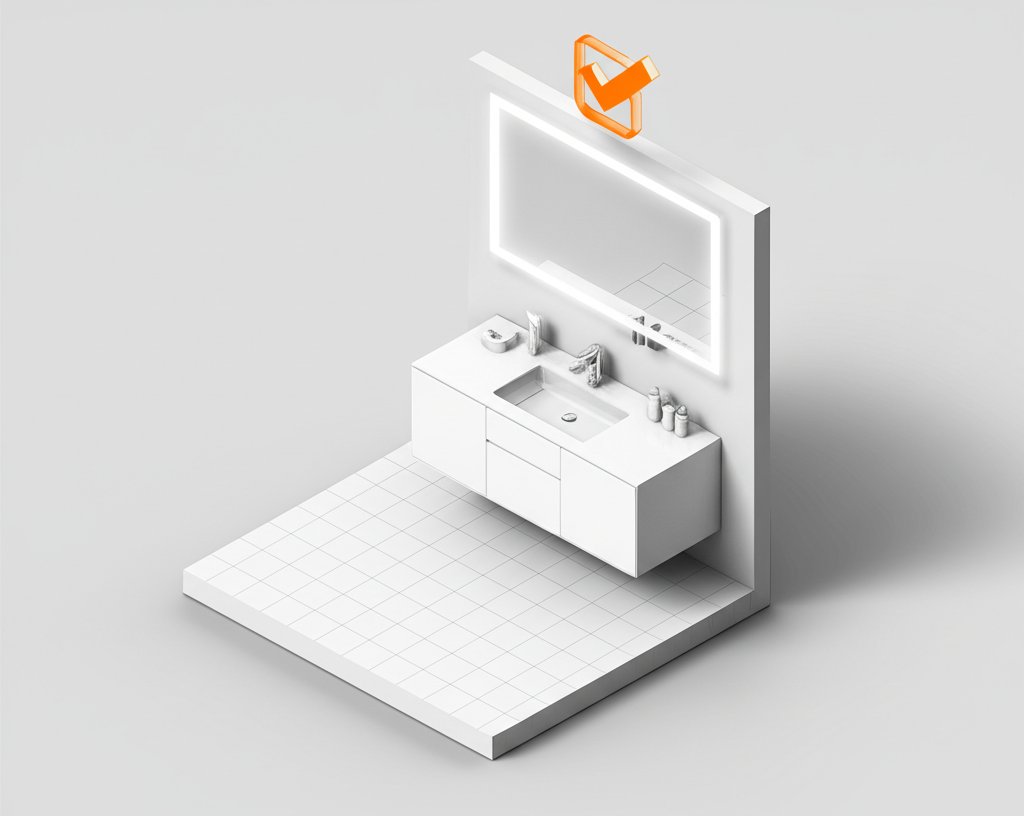
A vanity light is a key decorative element. Its style should feel like a deliberate choice that reinforces your bathroom’s overall design theme. Fixtures generally fall into three broad aesthetic categories.
Modern and Contemporary
Modern design prizes clean lines, geometric simplicity, and a lack of ornamentation. Look for linear bath bars, cubist sconces, and sleek metallic finishes.
- Key Features: Minimalist forms, straight lines, simple geometric shapes.
- Popular Finishes: Matte black, polished chrome, brushed nickel.
- Example Scenario: For a bathroom with a floating vanity and a frameless mirror, a long, horizontal LED bar from a brand like Modern Forms mounted above the mirror creates a streamlined, cohesive look.
Traditional and Classic
Traditional fixtures draw inspiration from historical designs. They often feature more detail, curved elements, and materials that evoke a sense of warmth and permanence.
- Key Features: Ornate details, glass shades (often bell-shaped or seeded), decorative arms.
- Popular Finishes: Aged brass, polished nickel, oil-rubbed bronze.
- Example Scenario: Flanking an ornate, framed mirror with two vertical sconces from Quoizel or Maxim Lighting adds a touch of classic elegance and provides beautiful, cross-illuminating light.
Transitional and Farmhouse
This versatile category bridges the gap between modern and traditional. It pairs simple, classic forms with updated finishes and materials for a look that is both timeless and fresh.
- Key Features: A blend of simple silhouettes with subtle traditional details. Often uses clear or seeded glass.
- Popular Finishes: Matte black, brushed gold, weathered zinc.
- Example Scenario: A simple bath bar from a brand like George Kovacs, featuring three distinct lights with a dark finish, can perfectly complement a shaker-style vanity and subway tile backsplash.
The Art of Placement: Sizing and Positioning for Flawless Light
Where you put your light is just as important as which one you choose. The goal is to cast even, shadow-free light across your face. Poor placement is the number one cause of bad bathroom lighting.
Getting the placement right is a core part of a complete bathroom lighting plan. For a comprehensive framework on layering ambient, task, and accent light, Read our LED vanity guide.
Horizontal Placement: The Above-Mirror Bar
A single light bar mounted horizontally above the mirror is a popular and effective solution, especially for wider vanities or when wall space is limited on the sides.
- Sizing Rule: Aim for a fixture that is roughly 75% of the width of your mirror or vanity cabinet. A 36-inch vanity works well with a 24- to 28-inch light bar. Avoid fixtures that are wider than the mirror, which can look unbalanced.
- Mounting Height: Position the center of the fixture about 75 to 80 inches above the finished floor. This height directs light downward at a flattering angle without being blocked by your head.
Vertical Placement: Sconces on the Sides
This is the gold standard for task lighting, preferred by makeup artists and designers. Placing lights on either side of the mirror creates cross-illumination, which fills in shadows under the eyes, nose, and chin.
- Sizing Rule: Choose sconces that are proportional to the mirror. A common height is around 18 inches, but this can vary with the style.
- Mounting Height: The center of the sconces should be at or just above eye level, typically 60 to 66 inches from the floor.
- Mounting Width: Place them a few inches from the sides of the mirror, with the centers of the lights roughly 36 to 40 inches apart to ensure the light fully envelops your face.
Expert Tip: Avoid the “Monster Lighting” Pitfall
Never rely on a single recessed light or flushmount fixture on the ceiling directly over your sink. This position casts light straight down, creating deep, unflattering shadows under your features—the same effect as holding a flashlight under your chin to tell a ghost story.
A Practical Playbook: Decoding the Tech Specs Like a Pro
The packaging and product pages for vanity led light fixtures are full of technical terms. Understanding these three key specifications will empower you to choose a light that performs as well as it looks.
| Specification | What It Is | Your Goal for a Vanity Light |
|---|---|---|
| Lumens (lm) | A measure of total brightness or light output. More lumens mean more light. | 700-1600 lumens total at the vanity. This is enough for detailed tasks without being blinding. A small powder room may need less, while a large double vanity will need more. |
| Kelvin (K) | A measure of light color temperature, from warm (yellowish) to cool (bluish). | 3000K to 4000K. 3000K (soft white) is a universally flattering choice. 4000K (neutral/cool white) offers crisp, daylight-like clarity ideal for precise makeup application. Avoid 2700K (too yellow) or 5000K+ (too clinical). |
| CRI | The Color Rendering Index measures how accurately a light source reveals the true colors of objects, on a scale of 0-100. | 90+ CRI. This is non-negotiable for a vanity. A high CRI ensures your foundation, clothing, and skin tone look the same in the bathroom as they do in natural daylight. A low CRI can make colors appear dull or shifted. |
| Finally, always check for a UL Listing. Because of the proximity to water, any fixture in a bathroom should be UL Damp-Rated. If the light will be placed inside a shower enclosure, it must be UL Wet-Rated. |
Quick Answers to Common Questions
Q: Are most vanity LED light fixtures dimmable?
A: Yes, many are, but it’s crucial to verify this in the product’s specifications. If you plan to dim your fixture, you must also purchase a compatible LED dimmer switch. Using an old incandescent dimmer with an LED fixture often results in flickering, buzzing, or poor performance. Check the fixture’s documentation for recommended dimmer types (usually ELV, TRIAC, or 0-10V).
Q: How do I clean an integrated LED fixture?
A: Cleaning is simple. Turn the light off and allow it to cool. Use a soft, dry or slightly damp microfiber cloth to wipe down the fixture and the acrylic or glass diffuser. Avoid using abrasive pads or harsh chemical cleaners, as they can damage the finish or scratch the lens.
Q: Is a matte black or a polished chrome finish better for a bathroom?
A: This choice is purely about style and maintenance. Matte black offers a bold, modern look and is excellent at hiding fingerprints and water spots. Polished chrome is a timeless, brilliant finish that coordinates easily with most faucets and accessories but requires more frequent wiping to keep it free of spots.
Q: Can I install a vanity light fixture myself?
A: If you have solid experience with home electrical work and understand how to safely turn off power at the circuit breaker, installing a vanity light is a manageable DIY project. However, given that bathrooms are wet environments, we strongly recommend hiring a licensed electrician to ensure the installation is safe, secure, and up to local code.
Your Final Decision Checklist
Choosing the perfect vanity led light fixture doesn’t have to be overwhelming. Follow this simple, step-by-step process to narrow down your options and make a confident choice.
- Define Your Style: Start by identifying your bathroom’s decor (Modern, Traditional, Transitional) and select a finish (e.g., black, chrome, brass) that complements your faucet and hardware.
- Measure Your Space: Note the width of your vanity and your mirror. Measure the height from the top of the mirror to the ceiling. These dimensions will dictate the appropriate size for your fixture.
- Choose Your Placement: Decide between a horizontal bar above the mirror or vertical sconces on the sides. Sconces provide the best task lighting, but a bar is an excellent, space-saving alternative.
- Select Your Light Quality: Lock in your technical specs. Look for a fixture with a CRI of 90 or higher, a color temperature between 3000K and 4000K, and enough lumens (700-1600) for your needs.
- Verify the Details: Confirm the fixture is UL Damp-Rated and check for dimmability if you want that feature.
By focusing on these key details, you move beyond just picking a light and start designing an experience. You’ll create a bathroom that’s not just brighter, but a smarter, more functional, and more stylish reflection of you.

- DIY Bathroom Mirror Frame Designs on a Budget - October 12, 2026
- Creative Bathroom Mirror Border Ideas for Every Style and Budget - October 11, 2026
- Bathroom Finishes That Handle Moisture and Look Great - October 10, 2026