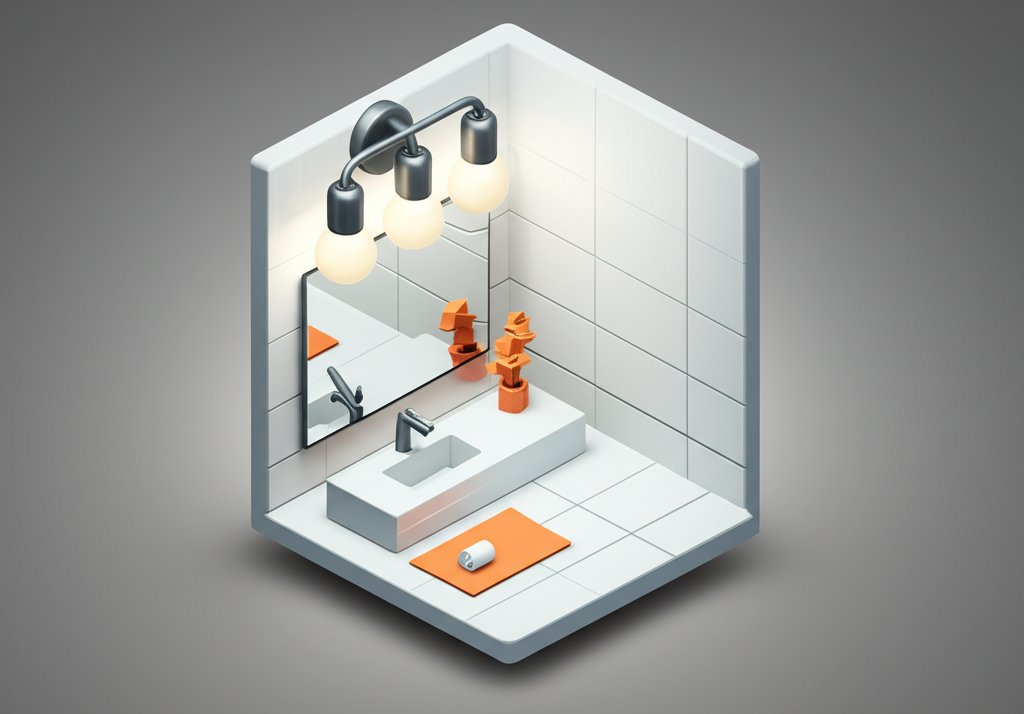
Choosing the right finish for your bathroom hardware can feel like a high-stakes decision, but the enduring appeal of bathroom vanity lights satin nickel makes it one of the safest and most stylish bets you can make. Unlike the high-shine of chrome or the bold statement of matte black, satin nickel offers a soft, sophisticated warmth that complements nearly any design scheme. It’s the versatile workhorse that ties a room together without demanding all the attention.
This finish masterfully bridges the gap between classic and contemporary, providing a subtle luster that feels both current and timeless. If you’re looking for a fixture that will look just as good in ten years as it does today, satin nickel is your answer.
At a Glance: Your Quick Guide to Satin Nickel
- Understand the Finish: Learn the key differences between satin nickel, brushed nickel, and polished chrome to make a confident choice.
- Perfect Proportions: Get a simple framework for sizing your vanity light based on your mirror and vanity width for a balanced, professional look.
- Master the Placement: Discover whether you should mount your light above the mirror or as sconces on the sides for the most flattering, shadow-free illumination.
- Light It Right: Find out which bulb color temperature (Kelvins) and brightness (lumens) create the ideal glow for grooming tasks and relaxing soaks.
- Style Synergy: See how satin nickel vanity lights can adapt to fit modern, transitional, and even farmhouse-inspired bathroom designs.
Decoding the Finish: Satin Nickel vs. The Alternatives
The world of metal finishes can be confusing, with terms that sound similar but look quite different. When you’re standing in a lighting aisle, knowing the subtle distinctions can make all the difference. Satin nickel’s primary strength lies in its incredible versatility.
Satin Nickel: The Soft, Low-Sheen Neutral
Think of satin nickel as the cashmere sweater of metal finishes. It has a smooth, silky surface that has been lightly etched to diffuse light, resulting in a low-sheen, almost velvety appearance. This process gives it a warmer, slightly more golden undertone compared to chrome.
Its biggest practical advantage? The soft finish is fantastic at hiding fingerprints, water spots, and smudges, making it a low-maintenance dream for a high-traffic area like a bathroom.
Brushed Nickel: The Textured Cousin
Brushed nickel and satin nickel are often used interchangeably, but they are technically different. A brushed nickel finish is created by abrading the metal with a wire brush, creating a pattern of very fine, parallel lines. This texture is visible up close and gives the finish a slightly more handcrafted, industrial feel. While both are excellent at hiding smudges, brushed nickel has a distinctly directional texture, whereas satin nickel is smooth. For a deeper look at its unique characteristics, our comprehensive Brushed nickel lighting style guide is an excellent resource.
Chrome: The High-Shine Classic
Chrome is the bold, reflective choice. It has a mirror-like finish with cool, blue undertones that works exceptionally well in stark, modern, or retro-style bathrooms. Its high-shine surface bounces light around the room, which can help a small bathroom feel bigger. The trade-off is maintenance; chrome shows every single water spot and fingerprint, requiring frequent polishing to keep it looking its best.
| Feature | Satin Nickel | Brushed Nickel | Polished Chrome |
|---|---|---|---|
| Appearance | Smooth, low-gloss, velvety | Fine lines, textured, soft sheen | Mirror-like, high-shine, reflective |
| Undertone | Warm, slightly golden/silver | Neutral to slightly warm | Cool, bluish |
| Maintenance | Hides fingerprints & water spots | Hides fingerprints & water spots | Shows everything; needs frequent cleaning |
| Best For | Transitional, contemporary, versatile | Industrial, modern farmhouse, traditional | Modern, minimalist, retro, art deco |
A Style for Every Space: From Farmhouse to Minimalist

One of the best qualities of bathroom vanity lights satin nickel is their chameleon-like ability to blend into various design aesthetics. The key is to match the fixture’s form and structure to your bathroom’s overall theme.
For the Modern & Contemporary Bathroom
In a modern bathroom, clean lines and simple geometry are paramount. Look for satin nickel fixtures that emphasize form over ornamentation.
- Linear Bar Lights: A sleek LED bar, mounted horizontally above the mirror, provides edge-to-edge, even lighting. Look for models with a metal body and a frosted or silicone diffuser for a soft, uniform glow.
- Geometric Shades: Fixtures with cylindrical or rectangular glass shades offer a minimalist appeal. Clear glass keeps the look open and airy, while frosted or opal glass provides a more diffused, ambient light.
- Integrated LEDs: Many modern vanity lights come with the LEDs built directly into the fixture, eliminating the need for bulbs and creating an ultra-streamlined silhouette.
Case Snippet: For a downtown condo bathroom with a floating oak vanity and large-format gray tile, a 36-inch satin nickel LED bar light was mounted above a frameless mirror. The warm glow of the 3000K light reflected beautifully off the nickel finish, warming up the otherwise cool-toned space.
For the Transitional & Traditional Bathroom
Transitional design elegantly blends the comfort of traditional style with the clean profiles of modernism. Satin nickel is the perfect finish for this marriage of old and new.
- Updated Classic Shades: Look for fixtures with bell-shaped, tapered, or schoolhouse-style glass shades. These shapes nod to tradition, but the satin nickel finish keeps them from feeling dated.
- Detailed Backplates: A fixture with a beveled, tiered, or rectangular backplate adds a touch of architectural detail without being overly ornate.
- Candle-Style Lights: For a more formal look, consider fixtures that mimic candlesticks, often with small fabric shades or exposed candelabra bulbs.
Case Snippet: A homeowner wanted to update her 1990s primary bath without a full gut renovation. She replaced an old polished brass fixture with a 3-light satin nickel vanity light featuring hand-blown, tapered glass shades. This single change, paired with matching satin nickel faucets, instantly modernized the space and bridged the gap between the existing oak cabinets and new gray floor tiles.
For the Farmhouse & Rustic Vibe
Satin nickel might not be the first finish that comes to mind for a farmhouse look, but it works beautifully as a softer alternative to oil-rubbed bronze or matte black.
- Gooseneck or Barn Lights: A single gooseneck sconce in satin nickel above a small, circular mirror in a powder room adds an industrial-farmhouse touch.
- Fixtures with Mixed Materials: Look for vanity lights that combine satin nickel with elements like wood-grain accents on the backplate or seeded glass shades, which add texture and a rustic feel.
- Clear, Simple Shades: Fixtures with simple clear glass shades, especially those that expose an Edison-style bulb, work perfectly in this aesthetic.
The Practical Playbook for Perfect Vanity Lighting
Choosing a fixture is only half the battle. Getting the size and placement right is what separates a good-looking bathroom from a well-lit, functional one.
Step 1: Measure Your Vanity and Mirror
Proportion is everything. A light that is too small will look lost, while one that’s too large can overwhelm the space.
- Rule of Thumb: Your vanity light fixture should be no wider than your mirror. Ideally, aim for a width that is roughly 75% of the mirror’s width.
- For Double Vanities: If you have a long vanity with two sinks and two mirrors, treat each one as a separate station and place a smaller fixture over each. If you have one long, single mirror over two sinks, you can use one long bar light (at least 75% of the mirror’s width) or two separate fixtures centered over each sink.
Step 2: Choose Your Mounting Style
How you mount your lights dramatically affects the quality of light on your face.
- Above the Mirror: This is the most common placement. Mount the fixture centered over the mirror, about 75 to 80 inches above the finished floor. This works well but can sometimes cast shadows under your chin and eyes.
- Sconces on the Sides: This is the gold standard for task lighting. Placing vertical fixtures or sconces on either side of the mirror provides even, cross-illumination that eliminates shadows. Mount them so the center of the light is roughly at eye level (60 to 66 inches from the floor) and about 30 to 36 inches apart.
Step 3: A Quick Sizing Cheat Sheet
Use this table as a starting point. Always measure your specific space.
| Vanity Width | Fixture Width (Approx.) | Placement Recommendation |
|---|---|---|
| 24″-30″ | 18″-24″ | One 2- or 3-light fixture above |
| 36″-48″ | 28″-36″ | One 3- or 4-light fixture above |
| 60″ Double | Two 18″-24″ fixtures | One fixture above each mirror |
| 72″ Double | One 48″+ bar light, or two 24″ fixtures | Centered over mirrors or one long bar |
Beyond the Fixture: Choosing the Right Glow

The most beautiful bathroom vanity lights satin nickel fixture can be ruined by the wrong light bulbs. Pay attention to three key factors: color temperature, brightness, and dimmability.
Color Temperature (Kelvins)
Measured in Kelvins (K), color temperature describes how warm (yellow) or cool (blue) the light appears.
- 2700K – 3000K (Warm White): This is the sweet spot for bathrooms. This light is universally flattering to skin tones, creating a welcoming, spa-like feel. It’s bright enough for tasks without feeling harsh or clinical.
- 3500K – 4000K (Cool White): This range produces a whiter, more neutral light. It’s excellent for precision tasks like applying makeup or shaving but can feel a bit sterile for general ambiance.
- 5000K+ (Daylight): This very blue-white light is often too harsh for a home bathroom and can make a space feel like an office or hospital.
Brightness (Lumens)
Forget watts—lumens are the true measure of a bulb’s brightness. For a vanity area where you’ll be grooming, you need ample light. The Illuminating Engineering Society (IES) recommends around 70-80 foot-candles (or 700-800 lumens per square meter) for vanity lighting. In practical terms, for a standard 3-light fixture, using three 800-lumen LED bulbs (the equivalent of a 60-watt incandescent) will provide excellent illumination.
The Dimmability Factor
A dimmer switch is non-negotiable for a modern bathroom. It allows you to have bright, task-oriented light when you’re getting ready in the morning and a soft, relaxing glow for a bath in the evening. Always ensure that both your light fixture and your chosen bulbs are rated as dimmable.
Quick Questions, Clear Answers
Is satin nickel out of style?
Not at all. Satin nickel is considered a timeless, classic finish. Unlike trend-driven finishes that can look dated in a few years (like the shiny brass of the ’80s), its soft, neutral appearance allows it to adapt to evolving styles. It has been a top choice for designers and homeowners for decades and shows no signs of falling out of favor.
Can I mix satin nickel vanity lights with other metals?
Absolutely! Mixing metals is a hallmark of sophisticated, layered design. Satin nickel pairs beautifully with matte black faucets and shower heads for a high-contrast, modern look. It can also be mixed with polished chrome or polished nickel, as long as you maintain a consistent design logic (e.g., all faucets are one finish, all lighting is another).
How do I clean satin nickel vanity lights?
Maintenance is simple. Use a soft, damp microfiber cloth to wipe down the fixture. For stubborn spots, a mild solution of dish soap and water is all you need. Never use abrasive cleaners, scouring pads, or harsh chemicals like ammonia or bleach, as they can damage the protective lacquer and ruin the finish.
Should my vanity light shades face up or down?
This depends on your lighting needs.
- Down-facing shades (Downlighting): This is the best choice for task lighting. It directs light straight down onto the countertop and your face, providing clear, direct illumination for shaving or makeup application.
- Up-facing shades (Uplighting): This creates more ambient, general room lighting. The light bounces off the ceiling and diffuses throughout the space, which can make a room feel larger and brighter overall but is less effective for tasks. Many modern fixtures are designed to be installed in either direction.
Your Next Step: From Selection to Installation
Choosing the right satin nickel vanity light comes down to a few key decisions. Before you buy, run through this final checklist to ensure you’ve covered all your bases.
- [ ] Confirm Your Style: Is your bathroom modern, transitional, or farmhouse? Choose a fixture shape that complements it.
- [ ] Measure Your Space: Note the width of your vanity and mirror to determine the ideal fixture size.
- [ ] Decide on Placement: Will you mount a single fixture above the mirror or install sconces on the sides for optimal task lighting?
- [ ] Plan Your Glow: Select bulbs with the right brightness (lumens) and a flattering color temperature (2700K-3000K is a safe bet).
- [ ] Demand Dimmability: Ensure both the fixture and bulbs are compatible with a dimmer switch for ultimate control.
By thoughtfully considering both the form of the fixture and the function of its light, you can select a bathroom vanity lights satin nickel fixture that not only looks beautiful but elevates your daily routine for years to come.

- DIY Bathroom Mirror Frame Designs on a Budget - October 12, 2026
- Creative Bathroom Mirror Border Ideas for Every Style and Budget - October 11, 2026
- Bathroom Finishes That Handle Moisture and Look Great - October 10, 2026