
That harsh, unflattering light casting shadows across your face in the bathroom mirror? It’s not you, it’s your lighting. For years, the single, lonely light fixture centered over the mirror—often called a “bath bar” or, less charitably, a “Hollywood” light—has been the default. But designers and homeowners are increasingly turning to a more elegant and effective solution: bath vanity sconces. Placed correctly, these fixtures transform a utilitarian space into a well-lit sanctuary, eliminating shadows and elevating your daily routine.
This isn’t just about adding more light; it’s about adding the right light in the right place. Sconces provide layered, flattering illumination that a single overhead fixture simply can’t match. They’re the difference between a bathroom that just works and one that feels thoughtfully designed.
At a Glance: Your Sconce Success Plan
Don’t have time to read everything? Here are the key takeaways for choosing and placing the perfect vanity sconces:
- Placement is Everything: The ideal spot for sconces is flanking the mirror at roughly eye level (about 60-66 inches from the floor). This creates “cross-illumination,” eliminating shadows on your face.
- Mind the Gap: Position sconces a few inches from the sides of your mirror and about 28 to 36 inches apart from each other for balanced light.
- Think in Lumens, Not Watts: For task lighting at a vanity, aim for a total of 700-1600 lumens. This is the measure of actual brightness.
- Get the Color Right: A color temperature between 2700K (warm white) and 4000K (neutral white) is ideal for bathrooms. Look for a high Color Rendering Index (CRI) of 90+ to see skin tones and makeup colors accurately.
- Safety First: Ensure any fixture you choose is UL-rated for “damp locations,” as bathrooms are high-humidity environments.
Why Sconces are the Secret to a Better-Lit Bathroom
The single biggest mistake in bathroom lighting is relying solely on an overhead source. When light comes from above your head, it casts deep shadows under your eyes, nose, and chin—what cinematographers call “monster lighting.” It’s incredibly unflattering and makes tasks like applying makeup, shaving, or styling your hair surprisingly difficult.
Bath vanity sconces solve this problem by providing light from the sides.
The Power of Cross-Illumination
By placing two sconces on either side of your mirror, you create a field of light that illuminates your face evenly from both sides. This is known as cross-illumination. It fills in those pesky shadows, providing clear, consistent, and flattering light for all your grooming tasks.
This approach is a core principle in a well-designed space. The relationship between Stylish Mirrors and Wall Sconces is fundamental to creating a functional and beautiful vanity area. It’s a simple change that delivers a professional-grade result every single day.
The Art of Placement: Where to Mount Your Vanity Sconces
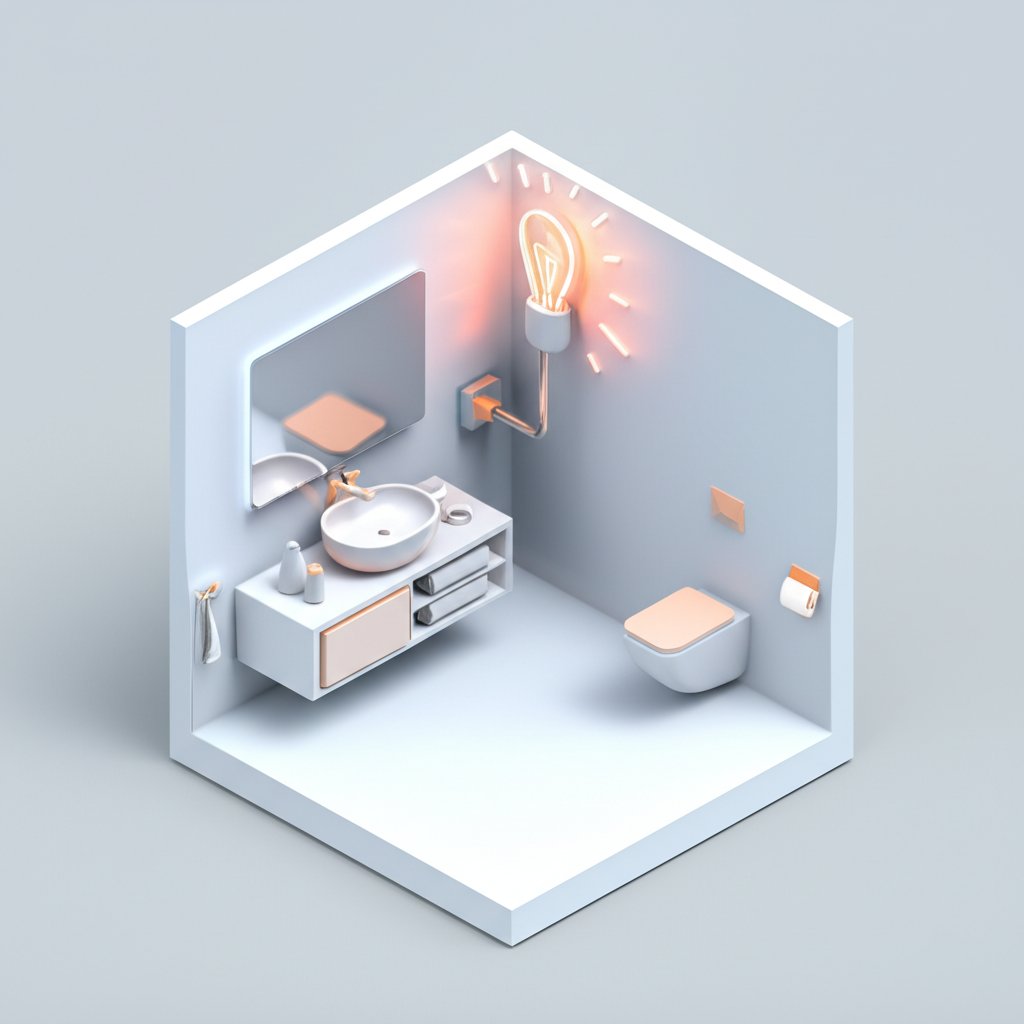
You can buy the most beautiful sconces in the world, but if you hang them in the wrong spot, you’ll be right back to fighting with shadows. Getting the placement right is non-negotiable.
The Golden Rule: Eye-Level and Flanking the Mirror
For optimal cross-illumination, sconces should be mounted on the wall on either side of your vanity mirror. The center of each light source should be roughly at your eye level.
- Standard Height: A good rule of thumb is to place the midpoint of the sconce 60 to 66 inches up from the finished floor. If the people using the bathroom vary significantly in height, aim for a comfortable average, around 65 inches.
This positioning ensures the light hits your face directly, not from too high or too low.
How Far Apart Should They Be?
Spacing is just as critical as height. You want the light to be wide enough to illuminate your whole face but not so wide that it feels disconnected from the mirror.
- Standard Spacing: Aim for a distance of 28 to 36 inches between the two sconces.
- Mirror Proximity: Each sconce should be mounted 3 to 6 inches from the side of the mirror. This keeps the light focused on the task area without creating awkward glare on the mirror’s surface.
For a standard 24- to 36-inch vanity, this formula works perfectly.
What About a Wide Mirror or a Double Vanity?
If you have a very wide mirror (over 48 inches) or a double vanity, a single pair of sconces may not be enough. You have a few options:
- Use Three Sconces: Place one on each side of the mirror and a third one centered above it to fill in the light.
- Use Multiple Sconces: For a long, trough-style sink and mirror, you could install three or even four smaller sconces spaced evenly above the mirror.
- Light the Stations: In a double vanity setup, treat each sink as its own “station.” Place a pair of sconces around each mirror, or use three sconces: one on the far left, one on the far right, and one shared between the two sinks.
This is just one part of a complete Guide to Bathroom Wall Lighting, but mastering it will have the biggest impact on your daily routine.
Decoding the Language of Light: How to Choose the Right Bulb
The fixture itself provides the style, but the bulb provides the light. Understanding a few key terms will help you choose a sconce that not only looks great but also performs beautifully.
Lumens, Not Watts: How Bright is Bright Enough?
For decades, we bought bulbs based on watts, which is a measure of energy consumption. With the advent of energy-efficient LEDs, watts are no longer a reliable indicator of brightness. Instead, look for lumens (lm).
For a vanity, you need bright, clear task lighting. Aim for a total output of 700 to 1600 lumens at the vanity. If you choose two sconces, each one should provide 350 to 800 lumens. Most product descriptions for LED fixtures will list the lumen output directly.
Color Temperature (Kelvin): Setting the Right Mood
Color temperature, measured in Kelvin (K), describes how “warm” or “cool” the light appears.
- Below 3000K (Warm White): This light has a cozy, yellowish glow, similar to a traditional incandescent bulb. It’s great for a relaxing, spa-like atmosphere but can make colors appear slightly yellow. 2700K is a popular choice for a warm feel.
- 3000K to 4000K (Neutral/Cool White): This range is often considered the sweet spot for bathrooms. It mimics natural daylight, providing a crisp, clean light that renders colors accurately without feeling sterile or blue.
- Above 4000K (Daylight/Cool Blue): This light has a distinct blueish tint. While it can feel very bright and energizing, it’s often too harsh and clinical for a home bathroom setting.
For most people, a bulb or integrated LED in the 3000K to 3500K range offers the best balance of function and comfort.
Color Rendering Index (CRI): Seeing True Colors
The Color Rendering Index (CRI) is a scale from 0 to 100 that measures how accurately a light source reveals the true colors of objects. This is crucially important at the vanity. A low-CRI light can make your skin look washed out or cause you to choose a foundation that looks completely different once you step outside.
For a bathroom vanity, look for a CRI of 90 or higher. This ensures that your skin tone, makeup, and clothing colors will appear accurate and natural.
Finding a Style That Speaks to Your Space
Now for the fun part: choosing a design. Bath vanity sconces come in a staggering array of styles, from sleekly modern to elegantly traditional. The key is to choose a fixture that complements your existing hardware, faucets, and overall aesthetic.
Modern & Minimalist
Think clean lines, simple geometric forms (cylinders, rectangles), and unadorned finishes. Modern sconces often feature integrated LED technology, allowing for incredibly slim and futuristic profiles.
- Materials: Matte black, polished chrome, brushed nickel, steel.
- Shades: Clear or frosted glass cylinders, simple white globes.
Traditional & Classic
These sconces draw inspiration from timeless designs. You’ll see candlestick-style arms, elegant curves, and decorative details like finials and fabric shades.
- Materials: Polished nickel, aged brass, oil-rubbed bronze.
- Shades: White linen or silk drum shades, etched or frosted glass with classic shapes like bells or empires.
Industrial & Farmhouse
This style celebrates raw materials and utilitarian forms. Look for exposed-filament Edison bulbs, cage-like shades, and plumbing-inspired details.
- Materials: Blackened iron, galvanized steel, aged copper, natural wood accents.
- Shades: Clear glass (to show off the bulb), metal domes, or wire cages.
Glam & Art Deco
For a touch of drama, glam sconces are the perfect choice. They often incorporate crystalline forms, bold geometric patterns, and luxurious finishes.
- Materials: Polished brass, gold leaf, high-shine chrome, natural stone like alabaster.
- Shades: Faceted crystal, milk glass, or unique sculpted forms. These fixtures are a cornerstone of many Luxury bathroom lighting ideas.
When you’re just starting your search, it can be helpful to browse a wide variety of Bathroom sconce lighting ideas to discover what you’re drawn to.
The Nitty-Gritty: Installation and Safety

Before you make a final decision, there are a few practical considerations to keep in mind.
Understanding UL Ratings: Damp vs. Wet
Electrical fixtures are tested and rated for safety by organizations like Underwriters Laboratories (UL). For a bathroom, you need to pay attention to the location rating.
- Damp-Rated: This is the standard for most bathroom lighting. These fixtures are designed to withstand moisture and condensation, making them safe for use near a sink or shower (but not in direct contact with water). Your vanity sconces should be damp-rated.
- Wet-Rated: These fixtures are built to withstand direct exposure to water. They are required for lighting inside a shower enclosure or in an exposed outdoor location.
Dimmers: Your Secret Weapon for Ambiance
Installing your sconces on a dimmer switch is one of the best upgrades you can make. It gives you complete control over the light level. You can have bright, focused light for your morning routine and then dim it down for a relaxing bath in the evening. Just be sure that your sconce and the bulbs you choose are “dimmable.”
DIY or Hire a Pro?
If you are simply replacing existing sconces and the wiring is in the right place, this can be a straightforward DIY project for someone comfortable with basic electrical work. However, if you are running new wiring—for example, splitting a single overhead box into two sconce boxes—it is highly recommended to hire a licensed electrician. They will ensure the work is done safely and up to code.
Once you know what style and features you’re looking for, it’s easier to Find Your Bathroom Wall Lights that meet your needs.
Common Questions Answered
Still have questions? You’re not alone. Here are answers to some of the most common queries about vanity sconces.
Can I mount sconces horizontally above my mirror?
Some sconces, particularly linear or bar-style designs, are designed for horizontal mounting. However, a pair of vertically-oriented sconces flanking the mirror will almost always provide more flattering, shadow-free light on your face.
How many sconces do I need for my vanity?
For a single-sink vanity up to 48 inches wide, two sconces (one on each side) is the gold standard. For double vanities or extra-wide setups, you might consider three or four fixtures to ensure even coverage.
What’s the difference between a “sconce” and a “vanity light”?
The terms are often used interchangeably. Generally, a “sconce” is a single wall-mounted light. A “vanity light” or “bath bar” is typically a multi-bulb fixture designed to be mounted above a mirror. For the best quality of light, individual sconces are preferred.
Are LED sconces a good choice?
Absolutely. Integrated LED sconces are incredibly energy-efficient, last for tens of thousands of hours (meaning you may never have to change a bulb), and allow for very creative and slim designs. Just be sure to check the lumens, Kelvin, and CRI ratings before you buy.
How do I light a small bathroom or powder room?
In a tight space, sconces are even more important. A bulky overhead fixture can make a small room feel cramped. Slim, well-placed sconces can provide ample light without taking up visual space. You’ll find many compact and powerful Small bathroom sconces designed for this exact purpose.
From Inspiration to Installation: Your Path Forward
Choosing the right bath vanity sconces is a design decision that pays off every single day. By focusing on placement, light quality, and a style that resonates with you, you can create a bathroom that is not only more beautiful but infinitely more functional.
Ready to get started? Here’s a simple plan:
- Measure Your Space: Note the width of your mirror and vanity. Determine the ideal height (60-66 inches) and spacing (28-36 inches apart) for your sconces on the wall.
- Define Your Light Needs: Decide on a target brightness (700-1600 total lumens) and color temperature (2700K-4000K). Commit to a high CRI of 90+.
- Find Your Style: Browse different styles—modern, traditional, industrial—and identify what complements your existing bathroom finishes.
- Shop Smart: Filter your search for damp-rated, dimmable fixtures that meet your technical and aesthetic criteria.
Armed with this knowledge, you’re ready to move beyond basic lighting and choose fixtures that will make your bathroom shine.

- DIY Bathroom Mirror Frame Designs on a Budget - October 12, 2026
- Creative Bathroom Mirror Border Ideas for Every Style and Budget - October 11, 2026
- Bathroom Finishes That Handle Moisture and Look Great - October 10, 2026