For the bigger picture and full context, make sure you read our main guide on Best Vanity Lighting in Bathroom for Style and Function.
Getting the lighting wrong over your bathroom mirror can ruin an otherwise perfect renovation. The best bathroom vanity light fixtures don’t just look good; they cast even, flattering light that eliminates shadows, making everything from shaving to applying makeup easier and more precise. It’s the one detail that bridges the gap between a functional space and a personal sanctuary.
But with endless options, choosing the right one feels overwhelming. Do you go with sconces or a bar? Up-lighting or down-lighting? Modern or traditional? This guide cuts through the noise to give you a clear framework for making the perfect choice.
At a Glance: Your Vanity Lighting Cheat Sheet
- Placement First: Sconces mounted on either side of the mirror at eye level provide the most flattering, shadow-free light.
- Direction Matters: Down-lighting is best for focused tasks, while up-lighting creates softer, ambient illumination that mimics natural light.
- Scale is Key: A common mistake is choosing a fixture that’s too small. For a single light bar, aim for a width that’s roughly 75% of your mirror’s width.
- Prioritize Light Quality: Look for a high Color Rendering Index (CRI) of 90+ to see colors accurately. A color temperature of 3000K is a popular choice for a clean but warm feel.
- Safety is Non-Negotiable: Always choose fixtures that are “damp-rated” for durability in a humid bathroom environment.
The First Decision: Where to Place Your Lights
Before you fall in love with a specific fixture, you need to decide on its placement. This single choice has the biggest impact on function and is dictated by your bathroom’s layout.
There are three primary configurations, each with distinct advantages.
1. The Gold Standard: A Pair of Vertical Sconces
Experts agree: mounting sconces on both sides of the mirror is the ideal setup. This creates cross-illumination, a balanced wash of light that cancels out the harsh, unflattering shadows that a single overhead light creates under your eyes, nose, and chin.
- Best for: Flawless task lighting for makeup, shaving, and grooming.
- Placement Tip: Mount them so the center of the light source is roughly at eye level, typically 60-66 inches from the floor. They should be about 30-36 inches apart, flanking the mirror.
- Case Snippet: For a client with a 48-inch vanity and a 30-inch mirror, we installed two 18-inch tall sculptural sconces. This not only provided perfect, shadowless light but also served as a decorative element, framing the mirror like artwork.
2. The Classic Workhorse: The Over-the-Mirror Light Bar
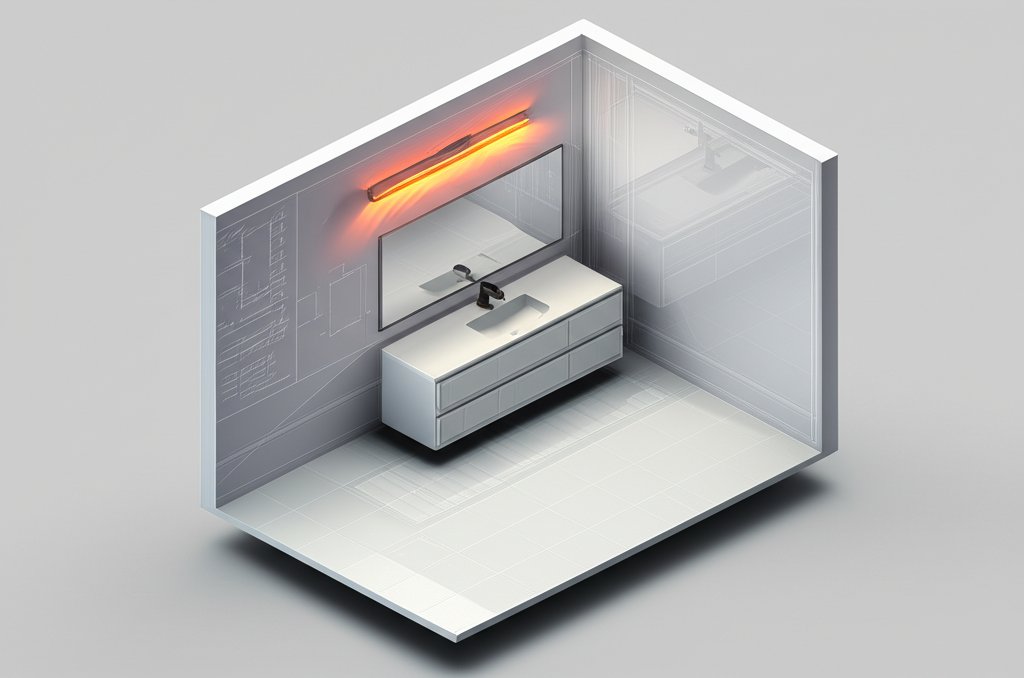
This is the most common setup, especially in smaller bathrooms or where wall space is limited. A single horizontal fixture mounted above the mirror casts light downward. While highly practical, it requires careful selection to avoid creating those pesky shadows.
- Best for: Guest baths, powder rooms, or bathrooms with wide mirrors or double vanities where side sconces aren’t feasible.
- Placement Tip: Mount the fixture about 75-80 inches from the floor, and a few inches above the mirror frame. To minimize shadows, choose a fixture with multiple bulbs spread out horizontally or one with a frosted glass diffuser to soften the light.
- A quick comparison:
| Feature | Side Sconces | Over-Mirror Bar |
| :— | :— | :— |
| Light Quality | Excellent (cross-illumination, no shadows) | Good (can create some shadows) |
| Aesthetics | Elegant, framing effect, decorative | Clean, traditional, space-saving |
| Best Use Case | Primary bathrooms, makeup areas | Smaller baths, double vanities |
3. The Designer’s Touch: Pendant Lights
Hanging one or two small pendants on either side of the mirror is a stylish, modern alternative to sconces. They add a touch of drama and can make a ceiling feel higher.
- Best for: Bathrooms with high ceilings where you want to make a design statement.
- Placement Tip: Ensure the bottom of the pendant hangs at or slightly above eye level. Crucially, this only works if you don’t have a medicine cabinet that swings open into the path of the light.
Get the Scale Right: A Simple Rule for Sizing Your Fixture
An undersized vanity light looks like an afterthought, while an oversized one can dominate the space.
For a single fixture above the mirror:
Choose a light bar that is no wider than your mirror and no less than half its width. The sweet spot is often around 75% of the mirror’s width. For example, a 32-inch-wide mirror pairs well with a 24-inch light fixture.
For two sconces flanking the mirror:
The height of the sconce is the key dimension here. They should feel substantial but not crowded. A sconce that is roughly one-third the height of the mirror often provides a pleasing balance.
For double vanities:
You have a few options:
- One long bar: A single fixture stretching across both mirrors can unify the space. Choose one that’s about 75% of the total width of the two mirrors combined.
- Two separate lights: Place a smaller bar (75% of the mirror width) over each mirror for a balanced, symmetrical look.
- Three sconces: Place one sconce on the far left, one on the far right, and one in the center between the two mirrors.
Decoding the Light Itself: Bulbs, Color, and Brightness
The fixture is just the housing; the light it produces is what matters most. Understanding these three technical terms will ensure you get beautiful, functional light. This is a foundational part of crafting a complete and effective bathroom environment, as we explain in our guide to best vanity lighting.
- Brightness (Lumens, not Watts): Wattage measures energy use, while lumens measure actual brightness. For a primary bathroom, aim for a total of 700-800 lumens at the vanity area. Small powder rooms might only need 400-500 lumens. If you use traditional incandescent bulbs, this translates to a 75-100 watt bulb for a main bath or a 40-60 watt bulb for a smaller one. With LEDs, you get the same brightness for far less wattage.
- Color Temperature (Kelvin): This measures how “warm” or “cool” the light appears, measured on a scale from 1,000K to 10,000K.
- 2700K: Very warm, cozy, and yellow—like a traditional incandescent bulb. Good for ambient light, but can distort colors for makeup.
- 3000K: Soft, clean white. This is the most popular choice for bathrooms as it’s flattering yet accurate.
- 4000K-5000K: Cool, crisp white that mimics daylight. Excellent for precise tasks but can feel sterile or clinical for some.
- Color Accuracy (CRI): The Color Rendering Index (CRI) measures how accurately a light source reveals the true colors of objects. The scale is 0-100, with 100 being natural sunlight. For a vanity, look for a CRI of 90 or higher. A low CRI can make your skin tones look off and your makeup colors appear different than they do outside. This is a non-negotiable feature for the best bathroom vanity light fixtures.
Style Guide: Matching the Fixture to Your Bathroom’s Vibe
With the technical decisions made, you can focus on aesthetics. The key is to choose a fixture that complements your home’s architecture and your bathroom’s design.
- Modern & Minimalist: Look for sleek LED bars with clean lines and minimal ornamentation. Finishes like matte black, chrome, or brushed nickel are common. The Ebern Designs Alfonza or the Brander model from the Drew & Jonathan Collection are great examples.
- Mid-Century Modern: Seek out fixtures with globe-shaped shades, warm wood accents (like walnut), and brass or bronze finishes. The “Sculptural Globe Sconce” or the “Sadaris 3-Light Vanity” fit this style perfectly.
- Industrial: Exposed Edison bulbs, dark metal finishes, and raw, mechanical details define this look. A five-bulb sconce with a cage or a simple bar with exposed bulbs can make a strong statement.
- Classic & Traditional: Think elegant details, candle-style lights, and fabric shades. The Scott Living Porteau, with its candle-like lights, or an updated “Hollywood” style four-bulb fixture can add a touch of timeless glamour.
- Farmhouse & Rustic: Look for fixtures with clear glass shades (like the Marsi Vanity Light, inspired by apothecary jars), distressed wood elements, or oil-rubbed bronze finishes.
Pro Tip: Don’t Be Afraid to Mix Metals
Your vanity light doesn’t have to perfectly match your faucet and showerhead. A matte black fixture can look stunning with brushed brass hardware. The key is to be intentional. A good rule of thumb is to stick to two metal finishes to keep the look cohesive rather than chaotic.
Quick Answers to Common Questions
A few questions pop up constantly when choosing vanity lighting. Here are the straight answers.
Q: Do vanity lights have to be centered over the sink?
A: No, they should be centered over the mirror. Your mirror is the visual anchor. If your sink is off-center to the mirror, prioritizing the mirror will create a more balanced and aesthetically pleasing result.
Q: Is up-lighting or down-lighting better for a vanity?
A: It depends on your goals. Down-lighting provides direct, focused task light, which is excellent for grooming. Up-lighting bounces light off the ceiling, creating softer, more ambient illumination with fewer shadows. Many modern fixtures are versatile and can be mounted in either direction. For the best of both worlds, use down-lighting at the vanity and supplement with an up-lighting ceiling fixture elsewhere in the room.
Q: What’s the best height for vanity lights?
A: For side sconces, the midpoint of the fixture should be at eye level (usually 60-66 inches from the floor). For an over-the-mirror bar, the bottom of the fixture should be a few inches above the mirror, which typically places it 75-80 inches from the floor.
Q: Should I put my vanity lights on a dimmer?
A: Absolutely. A dimmer is one of the most effective and affordable upgrades for any bathroom. It allows you to have bright, functional light when you’re getting ready in the morning and soft, relaxing light when you’re winding down with a bath in the evening. Just ensure both your fixture and your bulbs are dimmer-compatible.
Making the Final Call
Choosing the best bathroom vanity light fixture is a balancing act of function, scale, and style. By following this framework, you can move forward with confidence.
Start with the unchangeable facts of your space: the width of your vanity, the height of your ceiling, and the placement of your electrical junction boxes. This will immediately narrow your choices to sconces, a bar, or pendants. From there, layer on the technical needs—a high CRI and the right color temperature for your tasks. Only then should you dive into the exciting world of styles and finishes to find the perfect piece that pulls your whole bathroom together.

- DIY Bathroom Mirror Frame Designs on a Budget - October 12, 2026
- Creative Bathroom Mirror Border Ideas for Every Style and Budget - October 11, 2026
- Bathroom Finishes That Handle Moisture and Look Great - October 10, 2026