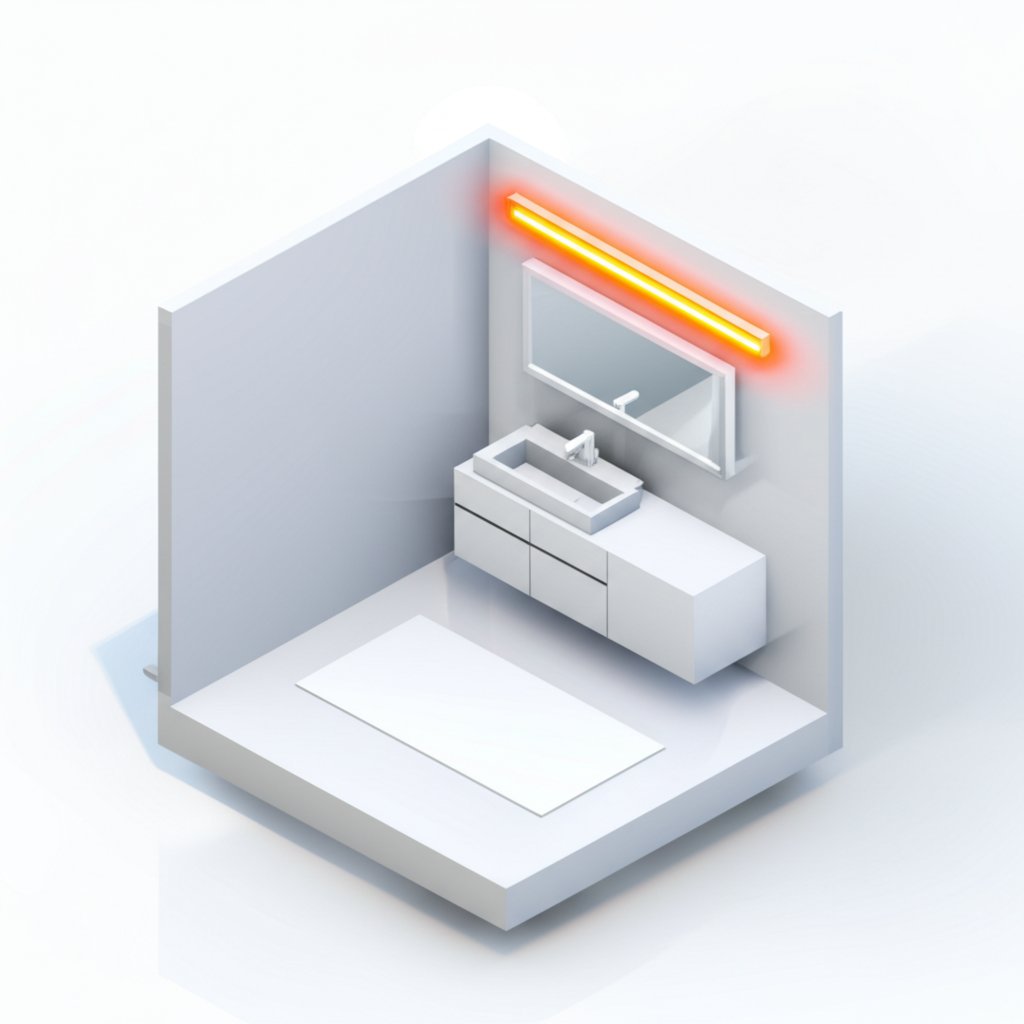
That old, outdated fixture above your bathroom mirror casts shadows that make your morning routine a guessing game. If you’re tired of uneven lighting, a modern linear vanity light is the single most impactful upgrade you can make. This isn’t just about brightness; it’s about clarity, style, and creating a space that feels both functional and intentionally designed.
Unlike traditional multi-bulb fixtures that create hotspots and dark spots, a linear vanity light provides a seamless, even wash of light across your face and countertop. It’s the secret to shadow-free makeup application, a perfect shave, and a bathroom that looks and feels like a high-end retreat.
At a Glance: Your Guide to Linear Vanity Lights
- Achieve Flawless Task Lighting: Understand why the continuous, even glow from a linear fixture eliminates shadows.
- Master Sizing & Placement: Learn simple rules for choosing the right length and where to mount it—horizontally or vertically—for maximum impact.
- Decode the Tech Specs: Get clear, simple explanations of lumens, color temperature (CCT), and CRI to select light that’s both bright and flattering.
- Match Your Style Perfectly: Explore how different finishes and designs, from minimalist bars to integrated mirror lights, fit your bathroom’s aesthetic.
- Avoid Common Installation Mistakes: Sidestep pitfalls like incorrect height placement and glare to ensure a professional-looking result.
The Defining Feature: Unbroken, Even Illumination
At its core, a linear vanity light is a single, elongated light source, often called a “bar” or “wand.” Instead of having distinct bulbs separated by space, it uses an integrated LED array behind a diffuser lens. This design is what creates its signature, unbroken line of light.
The result? You get beautifully consistent illumination from one end of your mirror to the other. There are no “valleys” of shadow between bulbs, which is a common issue with traditional globe or bell-shaped fixtures. This evenness is crucial for grooming tasks where precision matters. For a comprehensive look at the benefits of LED technology itself, from energy savings to lifespan, our complete LED vanity light guide provides an excellent foundation.
The sleek, low-profile form factor is another key advantage. It contributes to a clean, minimalist aesthetic that can make a small bathroom feel larger or bring a sense of modern order to a grand master bath.
Sizing It Right: How to Choose the Perfect Length
Choosing the wrong size is the most common mistake people make. A light that’s too short will look awkward and create shadows at the edges of the mirror. One that’s too long can overwhelm the space.
Follow these proven guidelines for a balanced, professional look.
For Horizontal Mounting Above a Mirror
The goal is to illuminate the full width of the primary use area.
- The 75% Rule: A great starting point is to choose a linear vanity light that is approximately 75% of the width of your mirror. For a 36-inch mirror, a fixture around 24 to 28 inches long is ideal.
- Stay Within the Mirror’s Frame: The light fixture should never extend beyond the edges of the mirror. It should be equal to or, more often, slightly shorter than the mirror’s width.
- Consider Vanity Width: If your mirror is the same width as your vanity, you can also size the light to be about 75% of the vanity’s width. For a 48-inch vanity, aim for a 36-inch light.
Case Snippet: For their 60-inch double vanity with two sinks, the homeowners initially considered two separate small lights. Instead, they opted for a single 48-inch linear vanity light mounted above the mirror. This single fixture provided more consistent light across both sinks and created a cleaner, more unified look.
For Vertical Mounting (Sconces)
Placing two shorter linear vanity lights vertically on either side of a mirror provides exceptional, cross-illuminating light that eliminates all facial shadows. This is the preferred setup for makeup artists and anyone who needs perfect task lighting.
- The Height Rule: Each vertical light should be roughly two-thirds to three-quarters the height of the mirror. For a 30-inch tall mirror, a 20- to 24-inch vertical bar on each side would be appropriate.
- Placement is Key: Mount the fixtures so the center of each light is roughly at eye level, typically 60 to 66 inches from the floor. They should be placed a few inches from the sides of the mirror, about 30 to 36 inches apart from each other to cast light evenly across your face.
Decoding Light Quality: More Than Just Brightness
Not all light is created equal. A linear vanity light is an investment in quality illumination, so understanding these three terms is critical.
- Lumens (Brightness): This measures the total amount of visible light. For a bathroom vanity, you need ample brightness for tasks.
- Guideline: Aim for 700-800 lumens per foot of fixture length. A 24-inch (2-foot) bar should offer at least 1400-1600 lumens. If it’s your bathroom’s only light source, you might want to go even higher.
- Color Temperature (CCT): Measured in Kelvin (K), this describes the color of the light, from warm to cool.
- 2700K: A warm, yellowish, incandescent-like glow. Creates a cozy, relaxing ambiance but can make colors look less true.
- 3000K (Ideal for Most): Soft, neutral white. Bright enough for tasks without feeling clinical. It renders skin tones and makeup colors accurately. This is the sweet spot for most residential bathrooms.
- 4000K+: A cool, blue-toned white, similar to daylight. Excellent for very precise tasks but can feel harsh or sterile in a home setting.
- Color Rendering Index (CRI): This is a scale from 0 to 100 measuring how accurately a light source reveals the true colors of objects. For a bathroom, this is non-negotiable.
- The Standard: Look for a CRI of 90 or higher. This ensures that your skin tone, makeup, and clothing colors look the same in the bathroom as they do in natural daylight. A low CRI light can make you look washed out or cause you to choose the wrong foundation shade.
| Light Spec | What it Means | Bathroom Recommendation |
| :— | :— | :— |
| Lumens | Brightness | 700-800 per foot |
| CCT (Kelvin) | Light Color (Warm/Cool) | 3000K (Neutral White) |
| CRI | Color Accuracy | 90+ |
Style and Finish: Matching Your Bathroom’s Aesthetic
The minimalist form of a linear vanity light makes it incredibly versatile. It can blend in or stand out, depending on the finish and design details you choose.
- Modern & Minimalist: A simple, unadorned bar in a matte black or brushed nickel finish is a hallmark of this style. It’s clean, functional, and puts the focus on the quality of light.
- Contemporary Glam: Look for fixtures in a polished chrome or brushed gold/brass finish. Some designs may incorporate subtle crystal or acrylic details to add a touch of sparkle without being ornate.
- Industrial Chic: A linear vanity light in an oil-rubbed bronze or dark metal finish, perhaps with exposed hardware details, can complement concrete countertops and open-shelf vanities perfectly.
- Integrated Designs: For the ultimate sleek look, some mirrors come with a linear vanity light built directly into the frame, either as a front-lit bar or a back-lit halo. This creates a seamless, high-tech feel.
A Practical Playbook for Installation
Proper installation is just as important as selecting the right fixture. Here’s how to plan for a successful outcome.
- Confirm Your Junction Box (J-Box) Location: Before you buy, check where your electrical box is located.
- Center Mount: Most horizontal fixtures are designed to be mounted to a single J-box centered above the mirror.
- Side Mounts: If you’re switching from an old fixture to two vertical linear sconces, you will likely need an electrician to install a second J-box.
- Offset J-Box: If your J-box is off-center, look for a linear vanity light with a long backplate that allows for some side-to-side adjustment.
- Measure for Height: The placement height affects glare and shadows.
- Above Mirror: Mount the fixture so the bottom is 75 to 80 inches from the floor. This typically places it a few inches above the mirror and casts light downwards onto your face and the counter without being in your direct line of sight.
- Side Mirrors (Vertical): As mentioned, the midpoint of the fixture should be at eye level, around 60-66 inches from the floor.
- Consider a Dimmer Switch: This is a must-have for versatility. A linear vanity light powerful enough for task lighting can be too bright for a relaxing bath. Installing a compatible LED dimmer (like an ELV-type dimmer) allows you to adjust the brightness to suit the mood and time of day.
Quick Answers to Common Questions
Q: Are linear vanity lights bright enough?
Yes, absolutely. Because they use integrated LED arrays, they are often much brighter and more efficient than traditional bulb-based fixtures. Pay attention to the lumen output—a 36-inch bar with 2,400 lumens provides powerful, consistent light for even a large vanity area.
Q: Can you mount a horizontal linear vanity light vertically?
It depends on the fixture’s rating. Many are rated for “damp locations” and can be mounted in either orientation. However, always check the manufacturer’s specifications. Some designs may not be intended for vertical mounting and could have issues with heat dissipation or aesthetics.
Q: Are the LEDs in a linear vanity light replaceable?
Typically, no. The LEDs are integrated directly into the fixture and are designed to last for a very long time—often 30,000 to 50,000 hours. This equates to decades of normal use. The trade-off for the sleek, seamless design is that you replace the entire fixture at the end of its life, not a bulb.
Q: Do linear vanity lights cause glare?
They can if installed improperly. The key is to choose a fixture with a good diffuser (the frosted or acrylic lens that covers the LEDs) and mount it at the correct height. Placing it too low or having it angled directly into your eyes will cause glare. When mounted correctly above the mirror, the light is directed down and forward, not out.
Your Next Step to a Better-Lit Bathroom
Upgrading to a linear vanity light is more than a style choice; it’s a functional transformation. You’re eliminating shadows, improving color accuracy, and creating a clean, modern focal point.
To get started, measure your mirror and vanity. Use the 75% rule to determine your ideal fixture length. Then, decide on your must-have light quality—insist on a CRI of 90+ and a CCT around 3000K for the most natural, flattering light. With those parameters set, you can confidently choose a finish that completes your bathroom’s look and enjoy perfectly even illumination every day.

- DIY Bathroom Mirror Frame Designs on a Budget - October 12, 2026
- Creative Bathroom Mirror Border Ideas for Every Style and Budget - October 11, 2026
- Bathroom Finishes That Handle Moisture and Look Great - October 10, 2026