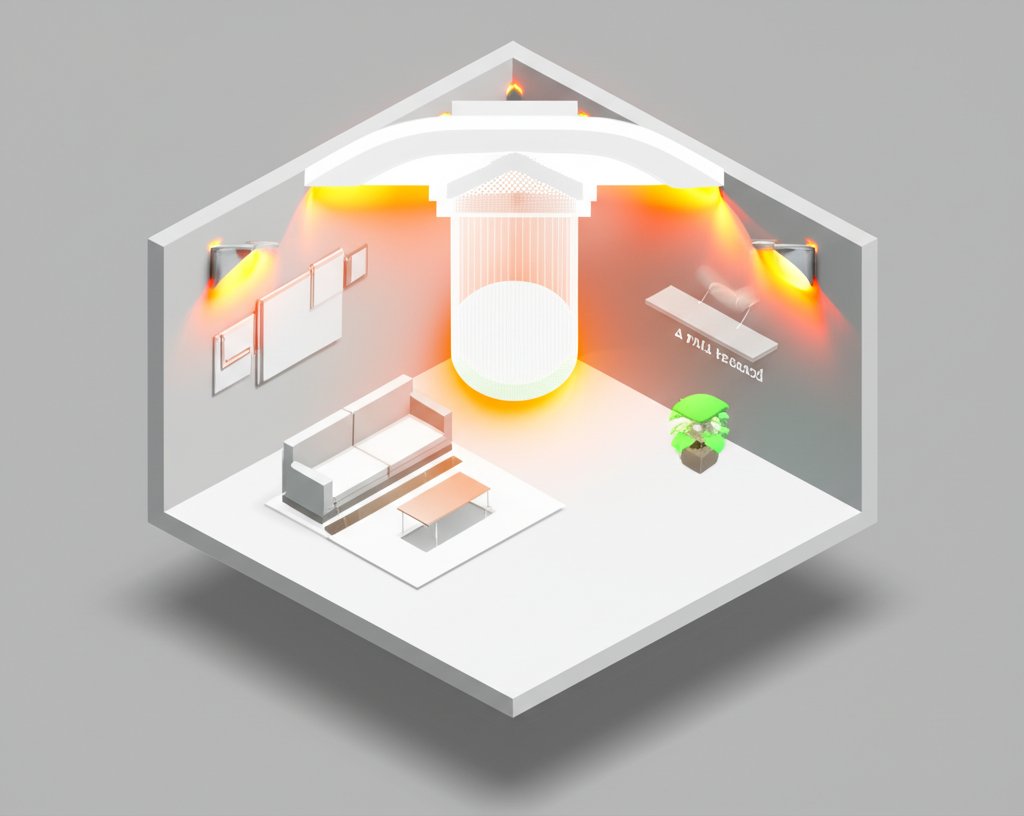
That harsh, central ceiling light—the one that casts strange shadows and makes everyone look tired—is a common design frustration. You want sophisticated, layered lighting, but the options feel overwhelming. This is where modern 4 inch recessed lighting steps in, not just as a light source, but as a powerful tool for shaping the feel of a room from the ceiling down. It’s the versatile workhorse that designers love for its ability to provide clean, focused light without dominating the visual space.
At a Glance: Your Key Takeaways
- The “Goldilocks” Size: Understand why 4-inch fixtures hit the sweet spot between the focused beam of 3-inch lights and the sometimes-bulky presence of 6-inch versions.
- Anatomy of a Recessed Light: Learn the critical differences between housing types (remodel vs. new construction) and trim styles (baffle, gimbal, etc.) to choose the right components.
- Mastering Light Quality: Go beyond brightness to control ambiance with color temperature (Kelvin), color accuracy (CRI), and beam angle.
- Layout is Everything: Get practical spacing rules and layout patterns for general, task, and accent lighting.
- Smart Integration: Discover how smart 4 inch recessed lighting unlocks new levels of control, from tunable whites to automated schedules.
Why 4-Inch is the Modern Standard
For years, 6-inch recessed lights were the default choice for builders. They were inexpensive and could flood a room with light. But “flooding” is often the problem. It creates a flat, uninteresting environment. Today, the design consensus has shifted squarely to the 4-inch format.
Think of it like a paintbrush. A 6-inch light is a wide roller, good for covering a large area with one coat, but clumsy for details. A 3-inch light is a tiny detail brush, perfect for highlighting a single object but impractical for lighting a whole room. A 4 inch recessed lighting fixture is the versatile 2-inch brush—it can cover the canvas efficiently while still giving you the control to create depth, focus, and drama.
This smaller aperture delivers a more refined, contemporary look. It allows you to create “pools” of light, layering them to build a scene rather than just blasting the room with uniform brightness. It’s the key to making a space feel intentionally designed, not just illuminated.
Decoding the Components: Housing, Trim, and Light Source
Choosing the right fixture starts with understanding its three main parts. Getting this right prevents headaches during installation and ensures the final look is exactly what you envisioned.
1. The Housing: The Unseen Foundation
The housing is the “can” itself, the part that goes into your ceiling. The most important decision here is choosing between a New Construction or Remodel housing.
- New Construction Housing: This is used when you have open access to the ceiling joists, like in a new build or a major gut renovation. It’s nailed or screwed directly to the joists before the drywall goes up, making it extremely secure.
- Remodel Housing: This is your go-to for existing ceilings. It’s designed to be installed from below through the hole you cut in the drywall. Clips on the side of the housing spring out to hold it firmly against the back of the drywall.
Another key factor is whether the housing is IC-rated (Insulation Contact). An IC-rated housing is approved to be in direct contact with ceiling insulation. A non-IC-rated housing requires a minimum clearance (usually 3 inches) from insulation, which can create energy loss. For 99% of residential applications, always choose IC-rated housing.
2. The Trim: The Part You Actually See
The trim is the decorative, visible portion of the light. It shapes the light and defines the fixture’s style. Here are the most common types:
| Trim Style | Description & Best Use Case |
|---|---|
| Baffle Trim | Features concentric ridges to absorb stray light and reduce glare. It’s the most popular choice for general, all-purpose lighting in living rooms and bedrooms. |
| Reflector Trim | Has a smooth, mirror-like interior to maximize light output. Use it in kitchens, home offices, or areas where you need bright, efficient light. |
| Gimbal Trim | An adjustable “eyeball” style that lets you pivot and direct the light beam. Perfect for accent lighting-aiming at artwork, a fireplace, or architectural details. |
| Wall Wash Trim | Designed with a scoop or shield that directs light asymmetrically to illuminate a vertical surface. It makes a room feel larger and brighter by evenly lighting a wall. |
| Lensed/Shower Trim | A flat, covered trim, often with a frosted lens. It’s “wet-rated” for use in showers, bathrooms, and outdoor soffits where moisture is a concern. |
3. The Light Source: Integrated LED vs. Bulb
The final piece of the puzzle is the light itself.
- Integrated LED: Most modern 4 inch recessed lighting fixtures are integrated LED units. The LED engine is built directly into the trim. They are incredibly energy-efficient and can last for 25,000-50,000 hours. The entire trim module is replaced when it eventually burns out.
- Traditional Bulb (Retrofit): You can also find housings that accept a separate bulb (typically a GU10 or an LED BR30). An LED retrofit kit is a popular option where an all-in-one trim and light source is designed to screw into an existing socket, instantly upgrading an old can.
For new installations, integrated LED is almost always the superior choice for its longevity, performance, and seamless design.
Fine-Tuning Your Ambiance: Color, Brightness, and Beam
The magic of great lighting isn’t just about having enough of it; it’s about having the right kind of it. Three key metrics will help you master the mood.
Color Temperature (Kelvin)
Kelvin (K) measures how “warm” or “cool” the light appears. This is arguably the most important factor in setting a room’s vibe.
- 2700K (Warm White): The cozy, yellowish glow of a traditional incandescent bulb. Ideal for bedrooms, dens, and living rooms where you want a relaxing, intimate atmosphere.
- 3000K (Soft White): A slightly crisper, cleaner white that’s still warm. A fantastic all-around choice for kitchens, bathrooms, and living spaces. It’s inviting but provides better clarity than 2700K.
- 4000K (Cool White): A neutral, vibrant white with a hint of blue. Excellent for task-oriented spaces like garages, home offices, or commercial settings. It can feel sterile in a living area.
- 5000K+ (Daylight): An intense, blue-white light that mimics direct sunlight. Best used for utility areas, workshops, or for special applications where high-visibility is crucial.
Many modern smart lights are “tunable white,” allowing you to adjust the Kelvin from a warm 2700K in the evening to a cool 4000K during the day to match your body’s circadian rhythm. This level of control is a game-changer for smart homes. For a complete breakdown of smart platforms and how to choose the right one, our comprehensive 4-inch smart ceiling light guide covers all the bases.
Color Rendering Index (CRI)
CRI measures a light source’s ability to reveal the true colors of objects, on a scale of 0 to 100. The sun has a CRI of 100. Low-CRI lighting can make food look unappetizing, clothes look drab, and skin tones appear washed out.
Pro Tip: For residential use, never settle for a CRI below 90. A high CRI (90+) ensures that the reds in your rug are rich, your kitchen cabinets show their true wood grain, and everything just looks right.
Beam Angle
This determines the size of the cone of light the fixture produces. A narrow beam (10-25 degrees) creates a dramatic, high-contrast spotlight, perfect for a gimbal trim highlighting a sculpture. A wide beam (40-60 degrees or more) creates a soft, diffuse flood of light, ideal for general ambient illumination with baffle or reflector trims. Most general-purpose 4-inch downlights have a beam angle in the 38-60 degree range.
Your Practical Playbook: A Simple Layout Strategy
Where you place your lights is as important as which lights you choose. A good layout creates an even, shadow-free environment.
Step 1: Layer Your Lighting
First, decide what each light’s job is. Most well-lit rooms use three layers:
- Ambient Lighting: The overall, general illumination of the room. This is the primary job of most recessed lighting layouts.
- Task Lighting: Focused light for a specific activity, like over a kitchen counter, a reading chair, or a desk.
- Accent Lighting: Light used to highlight an architectural feature or object, like a piece of art or a textured wall.
Step 2: Follow Basic Spacing Rules
For general ambient lighting with an 8-foot ceiling, a simple rule of thumb works well:
- Spacing Between Lights: Divide the ceiling height by two. For an 8-foot ceiling, space your 4-inch lights approximately 4 feet apart. For a 10-foot ceiling, space them 5 feet apart.
- Spacing from Walls: Place the first row of lights about half the distance of your between-light spacing from the wall. So, if your lights are 4 feet apart, place them 2 feet off the wall. This prevents harsh “scalloping” shadows on the wall.
Case Snippet: Kitchen Island Task Lighting - Problem: The homeowner’s 10-foot long kitchen island was always in shadow from the central ceiling light.
- Solution: We installed three 4 inch recessed lighting fixtures with reflector trims, spaced 3.5 feet apart and centered directly over the 3-foot wide island. Using 3000K, 90+ CRI lights, the countertop became a bright, functional, and beautiful workspace. The focused light eliminated shadows, making chopping and prep work safer and easier.
Quick Answers to Common Questions
Q: Can I install 4 inch recessed lighting myself?
A: If you’re simply swapping out an old fixture for a new one, it can be a straightforward DIY project. However, if you’re cutting new holes and running new wiring, it’s best to hire a licensed electrician. Electrical work requires knowledge of local codes to ensure safety.
Q: What’s the difference between a can light and a “canless” wafer light?
A: A traditional “can” light uses a housing installed in the ceiling. A “canless” or “wafer” LED light is an ultra-thin, all-in-one unit that doesn’t require a housing. Its remote junction box sits above the drywall. Wafers are fantastic for tight spaces, like ceilings with little clearance or obstructions, but traditional cans often offer more trim and adjustability options.
Q: Are remodel cans as secure as new construction cans?
A: When installed correctly, remodel cans are very secure. Their spring-loaded clips create strong tension against the back of the drywall. For a standard 4-inch LED fixture, which is very lightweight, a remodel can is more than sufficient.
Q: How many lights do I need for my room?
A: A quick formula is: (Room Square Footage) x (Foot-Candles Needed) / (Lumens per Fixture). For a living room, you might want 10-20 foot-candles. For a kitchen, 30-40. For example, a 150 sq. ft. living room needing 20 foot-candles requires 3,000 total lumens. If your chosen 4-inch lights are 600 lumens each, you would need 5 fixtures (3000 / 600 = 5).
Your First Step to a Better-Lit Home
Moving away from a single, overpowering light source is the single biggest upgrade you can make to your home’s atmosphere. Start with one room—perhaps the one where you spend the most time, like the living room or kitchen.
Sketch a simple plan of the ceiling. Think about where you need task lighting (over counters, by a reading chair) and where you want to create a general glow. Use the spacing rules as your guide and choose a warm, high-CRI light source. By replacing that one central fixture with a thoughtful layout of 4 inch recessed lighting, you won’t just be lighting a room; you’ll be designing an experience.

- Bathroom Decor Ideas for an Instant Style Refresh - September 16, 2026
- Retro Bathroom Lighting Ideas for Timeless Charm and Warmth - September 15, 2026
- Vintage Bathroom Light Fixtures Bring Timeless Character To Your Home - September 14, 2026