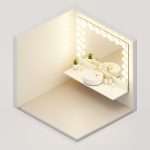
The perfect makeup application or the closest shave starts long before you pick up a brush or a razor. It begins with light. The wrong vanity light bulbs for a bathroom can cast unflattering shadows, make colors appear unnatural, and turn your morning routine into a guessing game. Get it right, however, and you create a space that’s not only functional but also feels like a daily luxury.
This is your expert guide to navigating the technical specs and style choices, ensuring the face you see in the mirror is the same one the world sees when you step outside.
At a Glance: Your Path to Perfect Vanity Lighting
- Prioritize Color Temperature (Kelvin): For task-oriented activities like makeup and grooming, a 5000K “Daylight” bulb is the industry standard for true-to-life color rendering.
- Understand Brightness (Lumens): Forget watts. Focus on lumens to determine a bulb’s actual brightness. Aim for 500-800 lumens per bulb for effective, non-glaring vanity light.
- Don’t Ignore CRI (Color Rendering Index): A CRI of 90+ is non-negotiable for accurately seeing skin tones, foundation shades, and clothing colors.
- Match the Bulb to the Fixture: Most vanity lights use a G25 globe shape with a standard E26 base, but always check your fixture’s requirements first.
- Decide on Dimmability: Dimmable bulbs offer ultimate flexibility, transitioning from bright task lighting to a soft, spa-like ambiance with the turn of a dial.
The Core Trio: Kelvin, CRI, and Lumens
Before you even think about bulb shape or brand, you need to master three key concepts. These elements work together to create light that is both flattering and functional.
Decoding Kelvin (K): From Cozy Glow to Clinical Clean
Kelvin is a measure of light’s color temperature—whether it appears warm and yellow or cool and blue-white. This is arguably the most critical choice for your vanity.
- 2700K – 3000K (Warm/Soft White): This is the cozy, inviting glow of traditional incandescent bulbs. It’s fantastic for creating a relaxing, spa-like atmosphere for a soak in the tub. However, its yellow-orange hue can significantly distort the appearance of your skin and makeup. Products like the Ascher Vintage G25 (2700K) are great for ambiance but are a poor choice for primary task lighting.
- 4000K (Cool/Neutral White): A solid middle ground. It’s crisper and less yellow than warm white but not as stark as daylight. Some people find this to be a good compromise for a multi-use bathroom. The Cotanic G25 LED bulbs (4000K) fall into this popular category.
- 5000K (Daylight): This is the pro’s choice for task lighting. It mimics natural daylight, providing a clean, bright light that renders colors accurately. For applying makeup, shaving, or tweezing, 5000K bulbs like the Sunco Vanity Globe or SHINESTAR 8-Pack ensure what you see in the mirror is true to life.
Practical Takeaway: If your vanity is your primary spot for grooming, choose 5000K bulbs. If you want flexibility, consider dimmable bulbs that allow you to soften the light when tasks are done.
Why a High CRI (Color Rendering Index) is Non-Negotiable
Have you ever put on foundation that looked perfect in the bathroom, only to see a distinct line on your jaw in the car’s rearview mirror? Low CRI was likely the culprit.
CRI measures how accurately a light source reveals the true colors of objects, on a scale of 0 to 100. Natural sunlight has a CRI of 100. For a bathroom vanity, where you’re matching skin tones and makeup shades, you need a high CRI.
- CRI 80+: This is the baseline for acceptable color rendering. Many budget bulbs sit here. It’s fine for general lighting but can still cause minor color shifts.
- CRI 90+: This is the gold standard for bathrooms. A 90+ CRI bulb, like the Sunco G25 LED Edison bulbs (CRI 90+), will show your skin, hair, and makeup in their truest, most vibrant colors. This is the detail that separates good lighting from great lighting.
Think of CRI as the resolution of your light. A low-CRI bulb is like a standard-definition TV—you get the general picture. A high-CRI bulb is like 4K Ultra HD—you see every detail with stunning clarity.
Lumens, Not Watts: How to Think About Brightness
For decades, we bought bulbs based on watts, which actually measures energy consumption. With energy-efficient LEDs, watts are no longer a reliable indicator of brightness. You must look at lumens.
Here’s a quick reference for how old incandescent watts translate to modern LED lumens:
| Incandescent Watts | LED Lumens (Approx.) | Best For |
|---|---|---|
| 40W | 450 lm | Softer, ambient lighting |
| 60W | 800 lm | Excellent all-around task lighting |
| 75W | 1100 lm | Very bright, for large spaces |
| 100W | 1600 lm | Intense brightness, often too harsh |
| For a standard multi-bulb vanity fixture, each bulb should ideally produce between 500 and 800 lumens. For example, the Dekang G25 bulbs offer a solid 600 lumens (a 60W equivalent), while the Ascher Vintage G25 bulbs are brighter at 750 lumens. Combining three or four of these bulbs provides ample, even light without creating harsh glare. | ||
| For a complete framework on how Kelvin, CRI, and Lumens fit into your overall lighting strategy, our pillar guide on Choosing Vanity Lights Bulbs is your next best read. |
The Practicalities: Bulb Shape, Base, and Features
Once you’ve nailed the light quality, you need to ensure the bulbs physically work with your fixture and lifestyle.
Decoding the Alphabet Soup: Bulb Shape and Base
G25 Globe: The Classic Vanity Choice
The “G” stands for Globe, and the “25” refers to its diameter in eighths of an inch (25/8″ or 3.125″). This round, classic shape is the most common choice for vanity light bars where the bulb is exposed. It provides a soft, even distribution of light.
ST58, A19, and Others: While G25 is the most popular, you might see other shapes. ST58 bulbs, like the Ascher Vintage LED Edison Bulbs, have an elongated, antique teardrop shape perfect for industrial or rustic decor. A19 is the standard pear shape you see in most lamps. Always choose a shape that complements your fixture’s design.
E26 Base: The Standard You Already Know
“E” stands for Edison Screw, and “26” is the diameter in millimeters. The E26 is the standard medium base used in the vast majority of light fixtures in the US. Nearly all the popular vanity bulbs, from Sunco to Hansang, use this base.
The Exception: The E12 Candelabra Base
Some smaller, more decorative sconces might use an E12 base, also known as a candelabra base. The Sunlite G16.5 Incandescent Globe Bulb is an example. Always double-check your fixture’s socket size before buying—it’s a simple mistake that can lead to a frustrating return.
The Feature That Changes Everything: To Dim or Not to Dim?
A dimmer switch is one of the most powerful tools for controlling your bathroom’s atmosphere.
The Case for Dimmable Bulbs
With dimmable bulbs, your bathroom lighting can do double duty.
- Morning: Full brightness (5000K) for flawless makeup application.
- Evening: Dimmed down to 20% for a warm, relaxing candle-lit feel during a bath.
Brands like Sunco and TORCHSTAR offer excellent dimmable G25 options. However, there’s a critical catch: you must have a compatible LED dimmer switch. Using dimmable LED bulbs with an old incandescent dimmer switch is the number one cause of flickering, buzzing, and premature bulb failure.
When Non-Dimmable Makes Sense
If your vanity is purely for tasks, you don’t have a dimmer switch, and you don’t plan on installing one, non-dimmable bulbs are a perfectly good choice. They are often slightly less expensive and offer a straightforward, reliable solution. The Winshine, Dekang, and SHINESTAR bulbs are all popular non-dimmable models that deliver excellent performance.
Your Vanity Bulb Shopping Checklist

Feeling ready to buy? Use this simple, step-by-step process to make the perfect choice every time.
- Inspect Your Fixture First:
- Base Size: Is it a standard E26 or a smaller E12? Unscrew an old bulb to check.
- Max Wattage: Look for a sticker inside the socket. While LED watts are low, you should never exceed the fixture’s maximum rating.
- Space: Is there enough room for a G25 globe, or do you need a more compact bulb?
- Define Your Primary Use:
- For Makeup/Grooming: Prioritize 5000K Daylight and a CRI of 90+. This is your non-negotiable starting point.
- For Ambiance/General Lighting: A warmer 2700K-3000K temperature will create a more relaxing feel.
- Calculate Your Brightness Needs:
- Aim for a total of 1500-2000 lumens surrounding the mirror for a small to medium bathroom.
- Divide your target by the number of sockets. For a 3-bulb fixture, bulbs around 600 lumens each would be ideal (3 x 600 = 1800 lumens).
- Decide on Dimmability:
- Do you already have a compatible LED dimmer switch? If yes, invest in dimmable bulbs for flexibility.
- If no, decide if you’re willing to install one. If not, save money and stick with high-quality non-dimmable bulbs.
- Choose Your Style:
- Clear vs. Frosted: Clear bulbs with visible filaments (Edison style) look great in vintage or industrial fixtures. Frosted bulbs provide a more diffused, softer light that can be easier on the eyes.
- Shape: Stick with the classic G25 globe for most vanities, or explore other shapes like the ST58 for a specific aesthetic.
Clearing Up the Confusion: Vanity Bulb FAQs
Q: What is the best wattage for vanity light bulbs?
This is the old way of thinking. Instead, focus on lumens. For most vanities, a 6W to 8W LED bulb that produces around 600-800 lumens is the equivalent of an old 60W incandescent bulb and provides excellent brightness for tasks.
Q: Are warm white or cool white bulbs better for a bathroom?
It depends on the zone and task. For the vanity area where grooming occurs, cool white (4000K) or daylight (5000K) is superior for color accuracy. For the general overhead light or a sconce near the tub, warm white (2700K-3000K) can create a more relaxing, spa-like atmosphere.
Q: Can I use any LED bulb in my bathroom?
You can, but it’s best to use bulbs rated for “damp locations.” Bathrooms are high-humidity environments, and a damp rating ensures the bulb’s internal components are protected from moisture, which prolongs its life. Most quality vanity bulbs carry this rating.
Q: Why do my new LED vanity bulbs flicker?
The most common reason is an incompatibility between a dimmable LED bulb and an older dimmer switch designed for incandescent bulbs. To fix this, either replace the switch with a modern CL-style (CFL/LED) dimmer or use non-dimmable bulbs.
Your First Step to a Flawless Reflection
Choosing the right vanity light bulbs for your bathroom isn’t about finding the brightest or most expensive option. It’s about creating an accurate and flattering light source tailored to your daily routine. By focusing on the essential trio—a 5000K color temperature, a CRI of 90 or higher, and 500-800 lumens per bulb—you build the foundation for a flawless look every single day.
For most bathrooms, the ideal starting point is a dimmable, G25-shaped LED bulb with an E26 base. This combination offers the task-ready precision you need in the morning and the relaxed ambiance you crave at night, proving that the best light is the one that adapts to you.

- Vanity Light Bulbs For Bathroom Choosing the Right Glow - September 9, 2026
- Top Bathroom Vanity Bulbs for Brighter Looks and Mood - September 8, 2026
- Choosing Vanity Lights Bulbs for a Flawless Morning Look - September 7, 2026