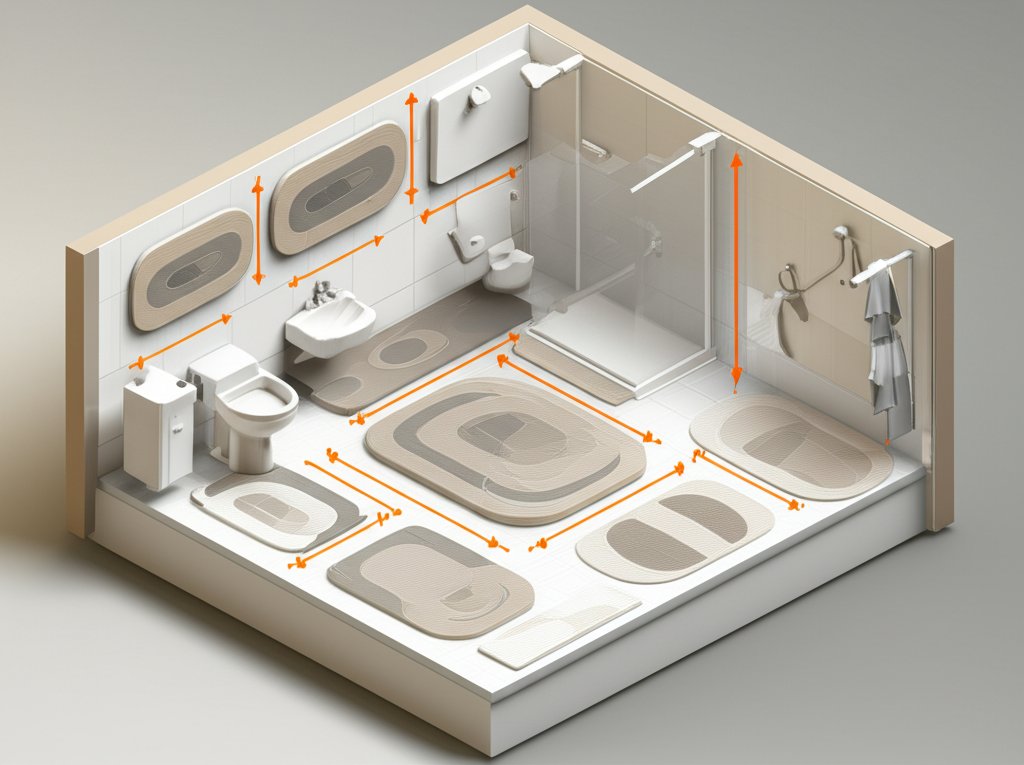
That beautiful, plush bathroom rug you envisioned can quickly become a design headache. Too small, and it looks like a forgotten postage stamp on an empty floor. Too large, and it overwhelms the space, curling up against the vanity or blocking the door. Getting the bathroom rug dimensions right isn’t just about aesthetics; it’s about function, flow, and even safety.
It’s the unsung hero that ties the room together, provides a soft landing for your feet, and keeps water off the floor. But with so many sizes on the market, choosing the right one can feel like a guessing game. This guide will end the guesswork for good.
At a Glance: Your Bathroom Rug Cheat Sheet
Pressed for time? Here are the key takeaways for choosing the perfect rug size:
- Standard Single Vanity: A 2’ x 3’ (24” x 36”) rug is the most common and versatile choice.
- Double Vanity: Use a long runner (like 2’ x 5’ or 24″ x 60″) that spans most of the length, or place two smaller rugs (like 17” x 24”) in front of each sink.
- In Front of a Tub/Shower: Look for a rug that’s slightly shorter than the tub. For a standard 60-inch tub, a 34” to 45-inch long rug works well.
- Small Bathrooms & Powder Rooms: A smaller 17” x 24” or 20″ x 30″ rug often provides enough coverage without crowding the floor.
- Around the Toilet: A 2’ x 2’ square rug or a contoured toilet rug (typically 20” x 22”) are standard options.
- Safety First: Always prioritize a rug with a non-slip rubber backing, especially in a wet environment.
Why Rug Size Is More Than Just a Number
Think of a bathroom rug as a frame for the functional areas of your room—the sink, the shower, the toilet. The right size creates a sense of purpose and visual cohesion. The wrong size does the opposite.
A rug that is properly scaled to your vanity, for example, makes the entire area feel intentional and well-designed. It defines the space where you stand to wash your hands or brush your teeth. Conversely, a runner that’s too short for a double vanity will look awkward and unfinished.
Beyond looks, the dimensions impact functionality. A rug placed by the shower needs to be large enough to catch every drip as you step out, but not so large that it stays perpetually damp or becomes a tripping hazard. It’s a delicate balance, but one that’s easy to strike once you know the rules of thumb.
The Core Four: Standard Bathroom Rug Sizes Explained
While you’ll find rugs in dozens of shapes and sizes, they generally fall into a few key categories. Understanding these helps you narrow down your options instantly. You can explore many Typical bath rug sizes for your space, but they usually fit into these common classifications.
| Rug Type | Common Dimensions | Best For |
|---|---|---|
| Small Mat | 17” x 24” or 20″ x 30″ | In front of pedestal sinks, stall showers, or in tiny powder rooms. |
| Standard Rug | 2’ x 3’ (24” x 36”) | The workhorse. Ideal for single vanities and in front of toilets. |
| Runner | 2’ x 5’ (24” x 60”) or longer | Double vanities, galley-style bathrooms, or along a freestanding tub. |
| Large/Area Rug | 4’ x 6’ or 5’ x 8’ | Large master bathrooms to cover a central open floor area. |
Small Rugs (Around 17″ x 24″)
This compact size is your go-to for tight spots. It’s perfect for a half-bath with a pedestal sink, providing just enough soft footing without covering too much precious floor space. It also works well in front of a narrow stall shower where a larger rug would get in the way of the door.
Standard Rugs (Around 2′ x 3′)
If you’re going to buy one rug, this is likely it. The 2’ x 3’ rectangle is the most popular and versatile size. It fits beautifully in front of a standard 30- to 48-inch single vanity. It offers generous coverage, ensuring your feet stay warm and the floor stays dry. This size can also be placed in front of a toilet for a more modern look than a traditional contoured rug.
Bathroom Runners (2′ x 5′ and Longer)
Runners are the perfect solution for long, narrow spaces. Their primary role is to provide a continuous path of comfort and style in front of a double vanity. A runner that spans from the edge of the first sink to the edge of the second creates a clean, unified look. They are also fantastic for galley-style bathrooms or for placing between a parallel tub and shower. Common lengths are 60 inches, but they can stretch to 71 inches or more for extra-long counters.
Large & Area Rugs (4′ x 6′ and Up)
In a spacious master bathroom, a small rug can feel lost. This is where a larger area rug comes in. A 4’ x 6’ or even a 5’ x 8’ rug can anchor the room, much like it would in a living room. It’s designed to cover the central floor space, leaving a border of 6-12 inches of visible flooring around the edges of the room. This adds a layer of luxury, warmth, and sound absorption.
Sizing for Your Specific Layout: A Practical Guide

The best way to find the right rug is to measure your space and match it to its function. Let’s walk through the most common bathroom scenarios.
In Front of a Single Vanity
Your goal here is balance. The rug should be slightly wider than the sink basin but narrower than the full vanity countertop.
- Rule of Thumb: Choose a rug that is about 75-80% of the vanity’s total width.
- Example: For a 36-inch vanity, a standard 24-inch wide (2’ x 3’) rug is perfect. For a smaller 30-inch vanity, a 20-inch wide rug would be a better fit. You want a few inches of flooring visible on either side of the rug.
For the Double Vanity Dilemma
You have two excellent options for a double vanity, and the choice comes down to personal preference.
- The Double-Rug Approach: Place one smaller rug (e.g., 17” x 24” or 20” x 30”) in front of each sink. This creates distinct personal zones and is easy to manage for washing. It works best when there is a set of drawers or a clear space separating the two sinks.
- The Runner Approach: Use a single, long runner (e.g., 24” x 60”) that spans the length of the vanity. This creates a more seamless, high-end hotel look. Measure your vanity and choose a runner that leaves about 3-6 inches of space on each end.
Pro Tip: If you choose a runner, make sure it’s long enough. A runner that only covers the two sinks but not the space in between looks undersized. It should cover at least 75% of the total vanity length.
Alongside the Bathtub or Shower
The rug here is all about function: catching water and providing a safe, warm spot to land.
- For a Standard Tub (60″ long): A rectangular rug that is 34″ to 45″ long is ideal. It should be long enough to cover the area where you step out but not so long that it runs the entire length of the tub. A standard 2′ x 3′ (24″ x 36″) rug often works perfectly.
- For a Stall Shower: The size depends on the door. For a pivoting door, place a small rectangular mat (17” x 24”) just outside the swing radius. For a sliding door, you have more flexibility and can use a slightly larger 20″ x 30″ or 24″ x 36″ rug.
- For a Freestanding Tub: You can place a small, plush rug (like a round 3′ rug or a rectangular 2′ x 3′) right where you step out. Or, for a more dramatic look in a large bathroom, you can place the entire tub on a large, waterproof area rug.
Around the Toilet
This is often a matter of taste.
- Contoured Rugs: These U-shaped rugs are designed to fit snugly around the base of the toilet. They typically measure around 20” x 22” or 20” x 26”. They offer full coverage but can sometimes look a bit dated.
- Rectangular Rugs: For a more contemporary feel, place a small rectangular or square rug in front of the toilet. A 2’ x 3’ rug works well if you have the space, or a 2’ x 2’ square rug can be a neat, modern alternative.
Rug vs. Mat: What’s the Real Difference?
The terms “bath rug” and “bath mat” are often used interchangeably, but they serve slightly different purposes, which can influence your size choice.
- A Bath Mat is a functional workhorse. Its primary job is to absorb water. It’s typically smaller (17″ x 24″ to 21″ x 34″), highly absorbent, and features a prominent non-slip backing. You place it directly outside the shower or tub and may even pick it up to dry between uses.
- A Bath Rug is more of a decorative element that also provides comfort and some absorption. Rugs come in a wider variety of sizes, including runners and large area rugs. While they should still be water-resistant and have a non-slip grip, their focus is often on adding warmth, color, and texture to the overall design.
You can absolutely use both. A small, functional bath mat for stepping out of the shower, and a larger, more decorative rug in front of the vanity.
Beyond the Tape Measure: 3 Crucial Factors Before You Buy
The right dimensions are only half the battle. To find the perfect rug, you also need to consider these three elements.
1. Material Matters (Absorbency & Durability)
Since bathrooms are damp environments, material choice is key. Look for fabrics that absorb water, dry quickly, and resist mold and mildew.
- Cotton & Chenille: Extremely soft and highly absorbent, giving you that spa-like feel. They can be slow to dry, so they’re best in well-ventilated bathrooms.
- Microfiber & Polyester: These synthetic fibers are champions of quick-drying. They are durable, stain-resistant, and hold color well, making them a practical choice for high-traffic family bathrooms.
- Bamboo: A sustainable and naturally anti-microbial option that’s great for resisting mold and mildew. It’s less plush but highly durable.
2. The Non-Negotiable: A Non-Slip Backing
This isn’t a feature; it’s a necessity. According to the CDC, over 200,000 non-fatal bathroom injuries occur each year in the U.S. alone, with a significant portion related to slips and falls. A wet floor is a major hazard.
Always choose a rug with a high-quality rubber or latex backing that will grip the floor firmly, even when damp. Avoid rugs without any backing, as they can easily slide out from under you.
3. Pile Height and Door Clearance
This is a detail people often forget until it’s too late. Before you fall in love with a super-plush, high-pile rug, check the clearance under your bathroom door. There’s nothing more frustrating than a rug that bunches up or prevents the door from opening and closing smoothly. A low-to-medium pile is usually a safe bet for most spaces.
Your Blueprint for the Perfect Fit
Choosing the right bathroom rug doesn’t have to be complicated. By focusing on your room’s layout and your daily needs, you can select a piece that is both beautiful and perfectly functional.
Follow this simple four-step process:
- Measure Your Key Zones: Grab a tape measure and note the width of your vanity, the length of your tub, and the open floor space you want to cover.
- Map Your Layout: Sketch out your bathroom and decide where you need a rug most—vanity, shower, toilet, or a central area.
- Match the Size to the Zone: Use the guidelines above to match the right rug dimensions to each specific area. Remember the 75-80% rule for vanities and runners.
- Material and Safety First: Once you know your size, filter your search for quick-drying, washable materials with a reliable non-slip backing.
With these principles in hand, you’re ready to choose a bathroom rug that not only fits your floor but fits your life.

- Bathroom Rug Dimensions for Every Room and Layout - October 28, 2026
- Bath Picture Ideas for Elegant and Creative Bathtub Photoshoots - October 27, 2026
- Bathroom Photoshoot Creative Angles Lighting and Props for Stunning Results - October 26, 2026