You’ve curated the perfect collection of brushes and found your holy-grail foundation. Yet, when you step outside, your flawlessly blended makeup looks patchy or the shade is slightly off. The problem might not be your products or your technique, but the inconsistent glow from your table vanity light. Getting this one piece of equipment right is the secret to a makeup routine that translates perfectly from your vanity to the real world.
At a Glance: Your Table Vanity Light Cheat Sheet
- Identify Your Type: We’ll break down the three main styles—Hollywood bulb mirrors, LED ring lights, and portable light bars—and match them to your space and needs.
- Master the “Big Three” of Light Quality: Understand what Color Rendering Index (CRI), Kelvin temperature, and lumens really mean for makeup application.
- Pinpoint Must-Have Features: Learn why dimmability and adjustable color temperature are non-negotiable for achieving a flawless look in any setting.
- Perfect Your Setup: Discover simple placement rules to eliminate unflattering shadows and create even, consistent illumination.
- Avoid Common Pitfalls: We’ll cover why a standard desk lamp fails as a makeup light and how to choose the right brightness for your eyes.
Beyond the Bulbs: Choosing the Right Style of Table Light
Not all tabletop lighting is created equal. The design you choose impacts everything from the quality of illumination to the aesthetics of your space. Let’s break down the most common options.
The Classic Hollywood Bulb Mirror
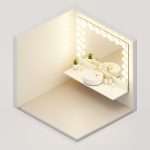
This is the icon—a mirror framed with round, globe-style bulbs. Originally designed for professional dressing rooms, this style provides powerful, diffuse light from multiple points, wrapping your face in illumination and minimizing shadows.
- Best for: Those who want a statement piece and the most glamorous, all-encompassing light. It’s ideal for dedicated vanity setups where space isn’t a major constraint.
- What to look for: Dimmable LED bulbs are a must. Old-school incandescent bulbs can get hot and cast a yellowish, inaccurate light. Look for models with bulbs that have a frosted or opal finish to soften the light and reduce glare.
Case Snippet: A freelance makeup artist, Sarah, struggled with consistent client results. She invested in a tabletop Hollywood mirror with dimmable, color-neutral LED bulbs. The multi-source lighting allowed her to see every detail without harsh shadows, ensuring her blending was seamless for every client, from bridal to editorial.
The Modern LED Ring Light
Popularized by content creators, the LED ring light is a fantastic tool for makeup. It produces a single, continuous band of soft, even light that erases shadows from the center of your face. This makes it incredibly effective for detailed work like winged eyeliner or precise lip lining.
- Best for: Makeup enthusiasts who also create content, anyone focused on precision, or those with smaller desks or vanities. Its minimalist design fits well in modern spaces.
- What to look for: A model with both adjustable brightness and color temperature. Many ring lights offer settings for warm, neutral, and cool light, which is invaluable for seeing how your makeup will look in different environments (e.g., the office vs. a restaurant).
The Versatile Portable Light Bar
These are the unsung heroes of makeup lighting. A portable table vanity light, often a stick-on or freestanding bar, offers targeted illumination. You can place it directly above or to the sides of an existing mirror, instantly upgrading your setup without buying a whole new mirror.
- Best for: Renters, travelers, or anyone needing to add quality lighting to an existing, non-illuminated mirror. Their small footprint makes them perfect for dorm rooms or multi-use desks.
- What to look for: Suction cup or non-damaging adhesive mounting options. Battery-powered or USB-rechargeable models offer the most flexibility, freeing you from needing a nearby outlet.
| Light Type | Primary Benefit | Ideal User | Key Feature to Seek |
| :— | :— | :— | :— |
| Hollywood Mirror | All-encompassing, glamorous light | Dedicated vanity owner | Dimmable, color-neutral LED bulbs |
| LED Ring Light | Shadow-free, focused illumination | Content creator, detail-oriented user | Adjustable color temperature |
| Portable Light Bar| Flexible, space-saving upgrade | Renter, traveler, minimalist | Rechargeable battery & easy mounting |
Decoding the Tech Specs: What Really Matters for Makeup
Lighting jargon can be confusing, but three key metrics directly impact how your makeup looks. Understanding them is the difference between a good light and a great one.
1. Color Rendering Index (CRI): Seeing True Color
CRI measures how accurately a light source reveals the true colors of an object compared to natural daylight. It’s scored on a scale of 0 to 100, with 100 (natural sunlight) being perfect. For makeup, this is the single most important metric.
- Why it matters: A low CRI light (below 80) can make colors appear dull or shifted. That perfect “true red” lipstick might look orange, or your foundation can appear ashy. You might over-apply blush or bronzer to compensate for the poor color rendering.
- What to aim for: Look for a table vanity light with a CRI of 90 or higher. This ensures that the foundation shade you see in the mirror is the same shade everyone else sees outdoors.
2. Kelvin (K): The “Temperature” of the Light
Kelvin measures the color temperature of light, from warm (yellowish) to cool (bluish). Think of a candle’s glow (around 1,900K) versus a bright blue sky (10,000K).
- Why it matters: Applying makeup in light that’s too warm or too cool will lead to application errors. Warm light can hide imperfections and make you under-apply concealer, while cool, fluorescent-style light can make you look washed out, causing you to over-apply bronzer.
- What to aim for: Natural daylight, the gold standard for makeup, is between 4,800K and 5,500K. A light that offers this “neutral white” setting is ideal. Even better is a light with adjustable Kelvin, so you can check your look in “warm” (for evening) and “cool” (for office) settings.
The principles of CRI and Kelvin are fundamental to achieving a professional result. To understand how they apply to every type of cosmetic lighting, from wall sconces to full-mirror installations, Explore vanity lights for makeup to get a comprehensive overview.
3. Lumens: The Brightness Factor
Lumens measure the total amount of visible light emitted by a source—in simple terms, its brightness. It’s tempting to think “brighter is better,” but that’s a common misconception.
- Why it matters: Light that’s too bright can be harsh, cause you to squint, and wash out your features, making it hard to see subtle color variations. Light that’s too dim forces you to lean in close and can hide unblended areas.
- What to aim for: Instead of focusing on a specific lumen count, prioritize dimmability. A light that allows you to adjust the brightness from a soft glow to a full, clear illumination gives you complete control. For most tabletop setups, a light that offers a range between 400 and 1,000 lumens is more than sufficient.
Your Tactical Guide to a Shadow-Free Setup
Even the best table vanity light will fail if it’s positioned poorly. The goal is to illuminate your face evenly from the front, eliminating any shadows that could mislead you during application.
Step 1: Aim for Facial Symmetry
Position your primary light source directly in front of your face at eye level. This prevents shadows under your chin, nose, and eyes. If your light is part of a mirror, this is done for you. If it’s a separate bar or ring, place it right above or around the mirror you’re using.
Step 2: Create a “Light Sandwich” if Possible
The professional ideal is to have light coming from both the left and right sides of your face simultaneously (cross-illumination). For a table setup, this can be achieved with a Hollywood-style mirror where bulbs frame the face. If using light bars, consider using two smaller ones on either side of your mirror instead of one on top.
Step 3: Control Your Environment
Turn off or dim any overhead room lighting. A strong ceiling light will cast harsh shadows down your face, working directly against your vanity light. Rely on your dedicated makeup light for the most accurate results.
Step 4: Mind the Distance
Sit about 1 to 2 feet away from your light source. This is close enough for the light to be effective but far enough to avoid glare and see your whole face.
Quick Answers to Common Questions
Here are some rapid-fire answers to the questions we hear most often.
Q: Can’t I just use a bright desk lamp for my makeup?
No, and for two key reasons. First, most desk lamps have a low CRI, which will distort colors. Second, they are single-point light sources, usually positioned overhead or to one side, which creates the exact shadows under the eyes and jawline that you need to avoid.
Q: Are battery-powered table vanity lights strong enough?
Absolutely. Modern LED technology is incredibly efficient. A good quality rechargeable table vanity light can provide bright, color-accurate light for hours. They are an excellent choice for clutter-free setups and travel. Just check the battery life specs before you buy.
Q: I bought a light with warm, neutral, and cool settings. Which one should I use?
Always start and do 90% of your application in the neutral/natural daylight setting (typically 4,800K–5,500K). This gives you the most accurate color representation. Then, briefly switch to the “warm” setting to see how your makeup will look in evening or restaurant lighting, and to “cool” to check it for an office or retail environment. This final check is a pro-level move.
Q: Do I need a mirror with a magnifying feature?
It depends on your needs. Magnification is extremely helpful for precision tasks like tweezing eyebrows, applying false lashes, or perfecting eyeliner. However, you should always do your final blend and color check in the non-magnified view to see the overall, real-world effect. Look for a mirror with a small, detachable magnifying mirror or a dual-sided design.
Making Your Final Decision
Choosing the right table vanity light doesn’t have to be complicated. It’s about matching the light’s features to your personal routine, space, and aesthetic. Start by identifying your primary need: Is it professional-grade color accuracy, a space-saving design, or a glamorous centerpiece for your room?
Once you know your priority, use the concepts of CRI, Kelvin, and dimmability as your non-negotiable checklist. A light with a CRI over 90 and adjustable brightness/temperature will always be a better investment than one that simply looks good but performs poorly. By focusing on the quality of the light first, you’re setting your makeup routine up for flawless success every single time.

- Table Vanity Light Options for Your Perfect Makeup Routine - September 12, 2026
- Makeup Vanity Lights for Mirror to Enhance Your Daily Look - September 11, 2026
- Vanity Lights for Makeup for the Best Flawless Application - September 10, 2026