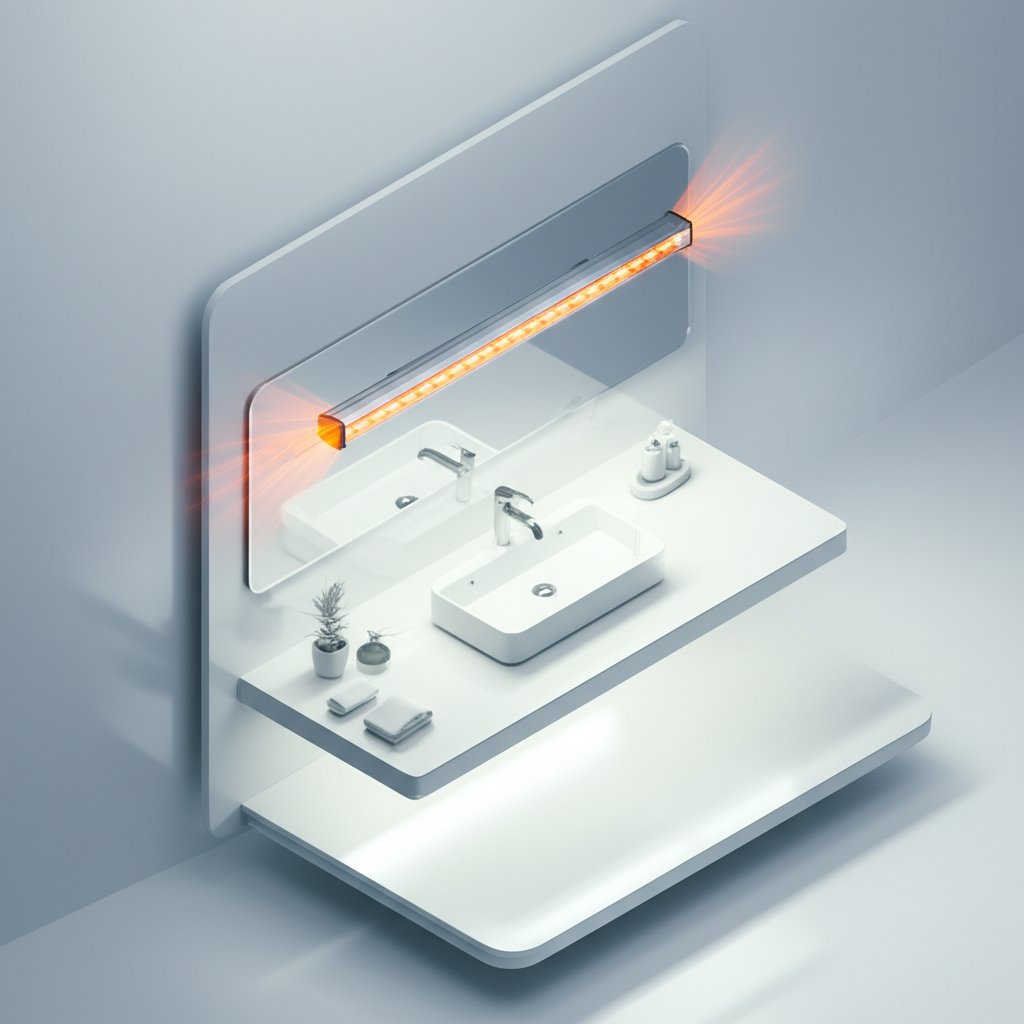
That old, builder-grade fixture glaring down from above your vanity does more than just cast unflattering shadows—it dates your entire bathroom. The quickest, most impactful way to bring your space into the present is with a modern bathroom light bar. Unlike their clunky predecessors, these fixtures are defined by clean lines, superior light quality, and a minimalist ethos that elevates the room from purely functional to intentionally designed.
This isn’t just about swapping one light for another. It’s about understanding how form, function, and technology converge to create a look that’s both beautiful and practical.
At a Glance: Your Modern Upgrade Path
- Embrace Integrated LED: Learn why modern fixtures have moved beyond replaceable bulbs for a sleeker look and better performance.
- Master Scale and Placement: Discover the simple rules for sizing your light bar to your vanity and mirror for a balanced, professional feel.
- Decode the Light Specs: Understand Kelvin, Lumens, and CRI to choose light that’s perfect for both tasks and ambiance.
- Avoid Common Pitfalls: Sidestep frequent mistakes like poor placement, ignoring dimmers, or choosing the wrong color temperature.
- Get a Practical Checklist: Walk away with a step-by-step plan to measure, select, and prepare for your installation.
What “Modern” Really Means for a Bathroom Light Bar
The concept of a “modern” light fixture has evolved. It’s less about a specific trend and more about a commitment to simplicity, efficiency, and integrated design. Two key shifts define this new generation of vanity lighting.
Ditching the Bulbs: The Shift to Integrated LED
The most significant feature of a truly modern bathroom light bar is the use of integrated LED technology. Instead of screwing in separate bulbs, the light-emitting diodes (LEDs) are built directly into the fixture itself. This might sound limiting, but the benefits are transformative.
- Sleek, Uninterrupted Design: Without the need to accommodate the shape and size of traditional bulbs, designers can create incredibly slim, linear, and sculptural forms that were previously impossible. The light source itself becomes a seamless part of the design.
- Even, Consistent Light: Integrated LED strips diffuse light evenly across their length, eliminating the “hot spots” and harsh shadows created by individual bulbs. This provides a more flattering and functional light for grooming tasks.
- Incredible Longevity: A typical integrated LED fixture is rated for 25,000 to 50,000 hours. If you use your vanity light for three hours every day, that’s a lifespan of 22 to 45 years. The “con” of not being able to replace a bulb is largely negated by the fact you likely won’t ever need to.
From Ornate to Minimalist: Key Design Elements
Modern design prioritizes function and form, stripping away unnecessary ornamentation. For a light bar, this translates to clean geometry and honest materials.
Look for fixtures that feature:
- Linear and Geometric Shapes: Simple horizontal bars, crisp rectangles, or even unadorned circular elements.
- Contemporary Finishes: Matte black is a dominant trend for its bold, graphic quality. Brushed brass and satin gold offer warmth without the dated shine of polished brass. Polished chrome and nickel remain classic modern choices for their clean, reflective properties.
- Minimal Hardware: Mounting plates are often slim and discreet, designed to blend into the wall or make the fixture appear to “float.”
While these principles define a modern bathroom light bar, understanding the full range of options, from sconces to multi-light bars, is a crucial first step. If you’re still exploring the fundamentals, take a moment to Choose the perfect vanity light.
Sizing and Placement for a Balanced, Professional Look
The most beautiful fixture can look awkward if its scale or position is wrong. Getting the proportions right is the secret to making your vanity area look intentional and high-end.
Getting the Scale Right: Matching Your Light Bar to Your Vanity
A common mistake is choosing a light bar that’s too small for the vanity. It creates a visual imbalance and can result in poor light distribution.
The Rule of Thumb: Aim for a light bar that is approximately 75% of your vanity’s total width. At a minimum, it should not be wider than your vanity cabinet, and ideally, it should be slightly narrower than your mirror.
Here’s a simple cheat sheet to guide you:
| Vanity Width | Recommended Light Bar Width | Notes |
|---|---|---|
| 24 – 30 inches | 18 – 24 inches | A single, centered bar works perfectly. |
| 36 – 48 inches | 28 – 36 inches | This is a common size; ensure the fixture feels substantial. |
| 60 – 72 inches | One 48+ inch bar OR two 24-28 inch bars | For double vanities, a single long bar creates a clean, unified look. Two smaller bars define each sink area. |
Case Snippet: A homeowner with a 60-inch double vanity initially installed two small 18-inch light bars, one over each mirror. The result felt disconnected and undersized. By replacing them with a single, 50-inch linear bar, the entire wall became a cohesive, sleek focal point, instantly modernizing the space.
The Ideal Height for Flattering, Shadow-Free Light
Where you mount the fixture is just as important as its size. The goal is to illuminate your face evenly without creating harsh shadows.
- Standard Placement: Mount the bathroom light bar horizontally above the mirror.
- Optimal Height: The center of the fixture should be between 75 and 80 inches from the finished floor. This typically places it a few inches above the top of the mirror.
This height directs light downward and forward onto your face, minimizing the ghoulish shadows under your eyes, nose, and chin that happen when a light is mounted too high.
The Technical Details That Make a Difference
A modern look is only half the battle. The quality of the light itself determines how well the space functions. Don’t get intimidated by the specs—they’re simple concepts that have a huge impact.
Decoding Light Temperature: From Warm Glow to Crisp Daylight
Light “color” is measured in Kelvin (K). This is arguably the most important decision you’ll make, as it sets the entire mood of the bathroom.
- 2700K – 3000K (Warm White): This is the color of a traditional incandescent bulb. It creates a cozy, relaxing, spa-like atmosphere. It’s wonderful for a powder room or for winding down, but its yellowish hue can distort colors, making precise makeup application challenging.
- 3500K – 4000K (Neutral/Natural White): This is the sweet spot for modern bathrooms. It’s a clean, bright white light that mimics natural daylight. It renders colors accurately, making it perfect for task-oriented activities like shaving or applying cosmetics.
- 5000K+ (Cool/Daylight White): This light has a distinct blueish tint and is very intense. While excellent for commercial or workshop settings, it can feel sterile and clinical in a home bathroom.
For a modern aesthetic that balances ambiance and function, stick to the 3500K to 4000K range.
Lumens and CRI: Getting Brightness and Color Accuracy Right
Once you’ve chosen the color, you need to ensure the light is bright enough and shows true colors.
- Lumens (Brightness): Forget watts; lumens measure the actual amount of light produced. For a primary vanity light, the American Lighting Association suggests you need at least 1,600 total lumens (the equivalent of a 100-watt incandescent bulb). Most modern LED bars will list their lumen output, making this easy to verify. For a double vanity, you’ll want closer to 3,000 lumens.
- CRI (Color Rendering Index): This is a scale from 0-100 that measures how accurately a light source reveals the true colors of objects. For a bathroom, this is non-negotiable. A low CRI will make your skin tones look off and your makeup colors appear different than they do outside. Look for a CRI of 90+ to ensure what you see in the mirror is what others see in natural daylight.
Why Dimmability is a Non-Negotiable Modern Feature
A modern bathroom is a multi-functional space. It’s where you get ready with bright, focused energy in the morning and where you unwind with a relaxing bath at night. A dimmer switch is the tool that makes this transition possible.
Installing your bathroom light bar on a dimmer allows you to have full, task-level brightness when you need it and a soft, ambient glow when you don’t. Just be sure to use a dimmer switch that is compatible with your LED fixture. Many modern LEDs require an ELV (Electronic Low Voltage) dimmer, so check the fixture’s specifications before you buy.
A Practical Playbook for Your Upgrade
Ready to make a change? A little preparation ensures a smooth process from selection to installation.
Your Pre-Purchase Checklist
Before you click “buy,” run through these quick measurements and checks:
- [ ] Measure Vanity Width: This determines your ideal light bar length.
- [ ] Measure Mirror Width: Ensure your chosen light is narrower than the mirror.
- [ ] Check Junction Box Location: Is the electrical box (where the wires come out of the wall) centered above your vanity? If not, you’ll need to plan for it.
- [ ] Verify Bathroom Rating: The fixture must be “damp-rated” for use in a bathroom. It protects the internal components from moisture and steam. A “wet-rated” fixture is only needed for inside a shower.
- [ ] Finalize Your Specs: Decide on your ideal finish (matte black, brushed brass, etc.), Kelvin temperature (aim for 3500-4000K), and ensure it has a CRI of 90+.
Installation Snapshot: Planning for Success
While we always recommend a licensed electrician for safety, understanding the process helps you plan.
- Safety First: The power to the bathroom must be turned off at the circuit breaker before any work begins.
- Assess the Junction Box: After removing the old fixture, look at the junction box. If it’s not perfectly centered where you need it, you have a few options: have an electrician move it (the best but most involved solution), or choose a new light bar with a long, rectangular backplate that can cover the box even if the fixture is mounted slightly off-center.
- Get a Helping Hand: Modern light bars can be long and unwieldy. Having a second person to hold the fixture in place while the wiring is connected makes the job much safer and easier.
Quick Answers to Common Concerns
Q: Can I install a bathroom light bar vertically?
A: Yes, but only if the fixture is designed for it. Some of the most striking modern looks involve flanking a mirror with two slim, vertical light bars. This provides beautiful cross-illumination that eliminates shadows completely. Always check the manufacturer’s installation guide to see if vertical mounting is supported.
Q: What if my junction box isn’t centered over the mirror?
A: You have three main options. The best solution is to hire an electrician to move the box. If that’s not in the budget, look for a bathroom light bar with a wide, forgiving mounting plate or a design where the canopy is centered on the fixture, giving you some leeway. Avoid fixtures with a tiny center-mount canopy.
Q: Are integrated LED light bars really worth it if I can’t replace the bulb?
A: For most people, absolutely. The technology is incredibly reliable, with lifespans often exceeding 20 years of normal use. By the time the LED fails, you’ll likely be ready for a style update anyway. The superior light quality, energy efficiency, and sleek designs are well worth the trade-off.
Q: Do I need a special light fixture for the shower area?
A: Yes. Any light inside a shower enclosure or directly over a bathtub must be “wet-rated,” meaning it’s sealed against direct water spray. The “damp-rated” bathroom light bar at your vanity is not safe for these high-moisture zones.
Your Next Step to a Brighter, Modern Bathroom
Upgrading your vanity lighting is one of the most transformative projects you can undertake in a bathroom. It’s a change that you will see and feel every single day. By focusing on the key decision points—getting the size right, choosing a minimalist integrated LED design, and dialing in the light quality with the right Kelvin and CRI—you can execute this upgrade with confidence.
Don’t let an outdated fixture hold your bathroom’s style hostage. A modern bathroom light bar is more than just a light source; it’s a statement piece that signals a commitment to clean design, functional excellence, and a space you truly love to be in.

- DIY Bathroom Mirror Frame Designs on a Budget - October 12, 2026
- Creative Bathroom Mirror Border Ideas for Every Style and Budget - October 11, 2026
- Bathroom Finishes That Handle Moisture and Look Great - October 10, 2026