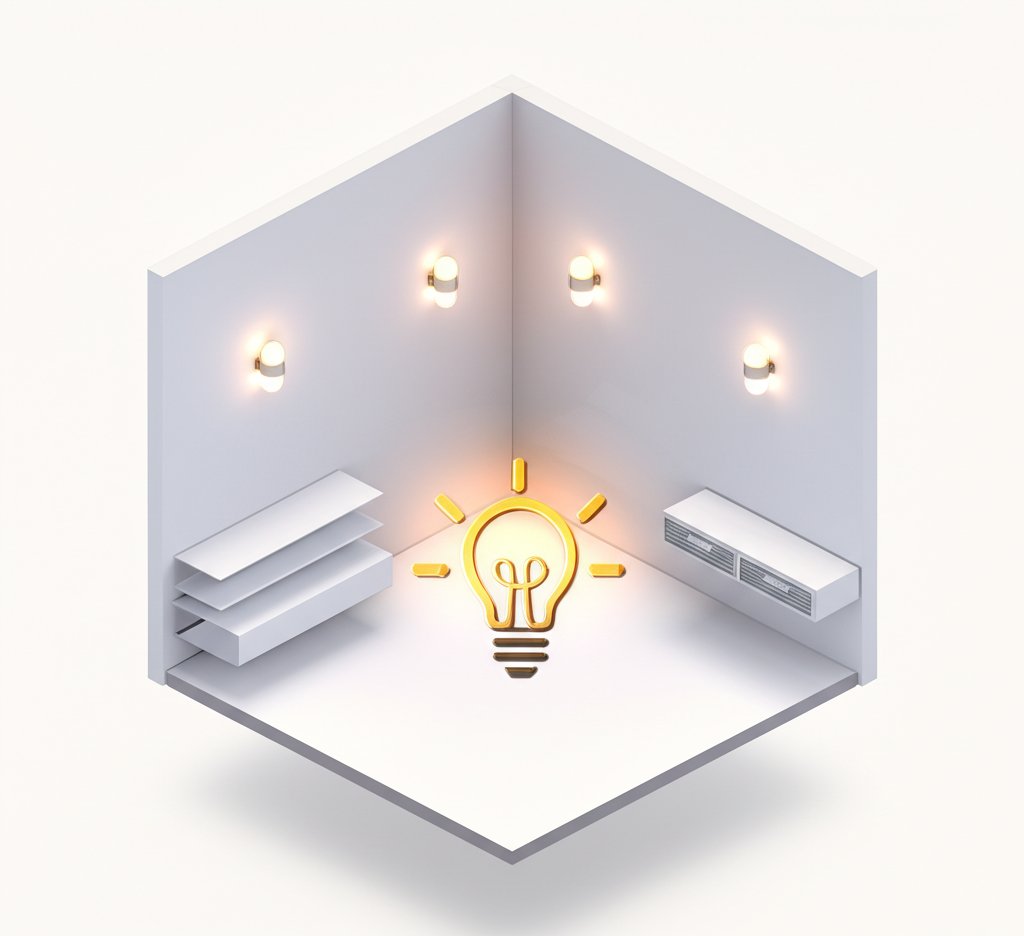
It’s the classic design dilemma: a narrow hallway, a cramped powder room, or a reading nook that feels more like a closet. You need light, but a floor lamp would be a tripping hazard and a table lamp has nowhere to sit. This is precisely where small sconce lights shift from being a mere accessory to a strategic design tool, solving spatial puzzles with a targeted glow and a touch of style. They prove that you don’t need a grand fixture to make a grand impact.
This guide moves beyond just picking a pretty light. We’ll break down the practical decisions—from size and projection to power source and placement—that turn a small sconce from an afterthought into a cornerstone of your room’s design.
At a Glance: Your Guide to Mastering Small Sconces
- Defining “Small”: Learn why a sconce’s “size” is about more than just its width, including its projection from the wall and overall visual weight.
- The Placement Playbook: Discover room-by-room rules for mounting sconces in hallways, bathrooms, and by bedsides for optimal function and flow.
- Hardwired vs. Plug-In: Get a clear comparison to help you choose the right power source for your budget, home, and DIY comfort level.
- Light Layering 101: Understand how to use small sconce lights to create ambient, task, or accent lighting that adds depth and mood.
- Actionable Answers: Find quick solutions to common questions about brightness, installation height, and bathroom safety ratings.
What Really Defines a “Small” Sconce Light?
When designers and lighting specialists talk about small sconces, they’re referring to a specific category, not just any light that looks tiny. Industry resources, like lighting retailer Grandlight, often categorize small sconces as those with a width between 3 and 8 inches. This provides a solid starting point, but the true measure of a “small” sconce is a combination of three factors:
- Width/Height: This is the most straightforward dimension. A fixture under 8 inches wide typically qualifies, ensuring it won’t overwhelm a narrow wall space between a window and a corner, or on a slim column.
- Projection (Depth): This is a critical, often-overlooked dimension. Projection is how far the fixture extends from the wall. In high-traffic areas like hallways or tight bathrooms, a low-projection sconce (under 4-5 inches) is essential to avoid being a hip-level obstacle. This is also a key factor for ADA (Americans with Disabilities Act) compliance in commercial or public spaces.
- Visual Weight: This is less about measurement and more about perception. A sconce with a heavy, dark metal base and a thick glass shade will have more visual weight than a minimalist sconce of the same size with a slender brass arm and an exposed bulb. For compact spaces, low visual weight is often your best friend.
While we’re focusing on the specific attributes of these compact fixtures here, you can find a broader overview of different types in our complete guide to Sconces for Small Spaces. Understanding these core dimensions empowers you to select a fixture that not only fits but truly belongs.
The Placement Playbook: Where to Mount Small Sconces for Maximum Impact
The right light in the wrong place is a wasted opportunity. Small sconce lights are precision instruments, and their placement dictates their function.
H2: Hallways and Corridors: Creating Rhythm and Flow
In a long, narrow hallway, a single overhead light often creates a “bowling alley” effect with harsh light in the center and dim, spooky ends. A series of small sconce lights is the solution.
- Spacing: A good rule of thumb is to space them 8 to 10 feet apart. Staggering them on opposite walls can add visual interest and provide more even illumination.
- Height: Mount them with the center of the fixture around 60 to 66 inches from the finished floor. This places the light source just above eye level, preventing glare.
- Projection: Keep it minimal. Choose sconces with a projection of 4 inches or less to ensure no one bumps into them.
Case Snippet: The Hallway Transformation
A client had a 15-foot hallway that felt like a tunnel. We installed three slim, vertical LED sconces (7″ high, 3.5″ wide, 3″ projection) on one wall, spaced 7.5 feet apart. The result? The light washed the wall, making the hallway feel wider, and the repeating fixtures created a pleasing architectural rhythm that drew the eye forward.
H2: The Bedroom: Perfecting the Bedside Glow
Free up your nightstand by replacing bulky table lamps with wall-mounted small sconce lights. This is where the choice between ambient and task lighting becomes crucial.
- For Reading (Task Lighting): Opt for an adjustable or swing-arm sconce. Mount it so the bottom of the shade is about 20-24 inches above the mattress, slightly to the side of where your head would be when reading in bed. This focuses light on your book, not in your eyes.
- For Ambiance (Ambient Lighting): A fixed sconce with an upward-casting or shaded light is ideal. Mount these slightly wider and higher, around 60-66 inches from the floor, to flank the bed symmetrically.
Pro Tip: If you choose plug-in sconces for the bedside, invest in cord covers you can paint the same color as your wall. It’s a small detail that makes a huge difference in creating a clean, high-end look.
H2: Bathrooms and Powder Rooms: Functional Elegance
In a bathroom, especially a small one, sconces flanking a mirror are superior to a single light above it. This cross-illumination minimizes shadows on your face, which is essential for grooming tasks.
- Placement: Mount a pair of small sconces on either side of the mirror, with the center of each fixture at roughly eye level (again, 60-66 inches is a standard). They should be about 30-36 inches apart to cast even light across your face.
- Safety First (UL Rating): This is non-negotiable. Any light in a bathroom must be UL-rated for its location. A sconce near a sink or shower needs a “Damp” rating. One inside a shower would require a “Wet” rating. Always check the product specifications.
Hardwired vs. Plug-In: Choosing Your Installation Path
This is one of the most significant decisions you’ll make. It boils down to aesthetics, budget, and your home’s existing wiring.
| Feature | Hardwired Sconces | Plug-In Sconces |
|---|---|---|
| Look & Feel | Seamless, built-in, and professional. No visible cords. | Visible cord, which can be styled or hidden. |
| Installation | Requires an electrician to run wires to a junction box. | DIY-friendly. Mounts to the wall like a picture frame. |
| Cost | Higher upfront cost due to professional installation. | Lower upfront cost. The price is just for the fixture itself. |
| Flexibility | Permanent. Moving it requires more electrical work. | Highly flexible. Can be moved to a different wall or home easily. |
| Best For… | New construction, major renovations, or a clean, minimalist aesthetic. | Renters, DIYers, or anyone wanting a low-commitment lighting solution. |
| A common pitfall is underestimating the cost of hardwiring. If a junction box doesn’t already exist where you want the light, an electrician will need to open the wall to run new wiring from a power source, which adds significant labor costs. Always get a quote before you purchase a hardwired fixture. |
Quick Answers to Common Questions
Getting the details right ensures your small sconce lights perform perfectly. Here are answers to the questions we hear most often.
Q1: Are small sconce lights bright enough to be the only light in a room?
Usually, no. Small sconce lights are masters of layered lighting. They are best used as a secondary source for tasks (like reading), ambient mood-setting, or accenting architectural features. In a very small space like a powder room or a tiny entryway, a pair of bright sconces might be sufficient, but in most rooms, they should be paired with a central ceiling fixture or recessed lighting.
Q2: What’s the best bulb type for a small sconce?
LED is almost always the answer. They are energy-efficient, last for years, and produce very little heat—a key safety feature for a fixture that’s mounted on a wall. Pay attention to two specs:
- Lumens (Brightness): For ambient light, 200-400 lumens per sconce is plenty. For task lighting, aim for 450-850 lumens.
- Kelvins (Color Temperature): 2700K produces a warm, cozy, incandescent-like glow. 3000K is a soft, neutral white that’s great for bathrooms and kitchens.
Q3: How do I choose a style that won’t look dated in a few years?
Focus on timeless shapes and finishes. A simple, elegant sconce in a classic finish like aged brass, matte black, or polished nickel will outlast fleeting trends. For modern spaces, look for minimalist profiles and geometric forms. For traditional or transitional homes, consider sconces with clean lines and simple fabric shades.
Your Action Plan for Choosing the Right Small Sconce
Don’t get overwhelmed by the options. Follow this simple decision-making process to find the perfect fixture.
- Define the Job: What do you need this light to do?
- Ambient: General, soft illumination (e.g., hallway).
- Task: Focused light for an activity (e.g., bedside reading).
- Accent: Highlighting art or architecture.
- Measure Everything: Get out your tape measure.
- Note the wall space available (width and height).
- Determine your ideal mounting height (usually 60-66″ from floor).
- Decide on a maximum projection depth you can live with (e.g., under 4″ for a hallway).
- Decide on Power:
- Do you have an existing junction box?
- Are you willing to hire an electrician?
- Or is a plug-in model the more practical choice for your situation?
- Select Style & Finish:
- Match the fixture to your home’s existing hardware and architectural style. When in doubt, a simple, low-profile design in a neutral finish is a safe and stylish bet.
By thinking through placement and purpose first, you transform shopping for small sconce lights from a guessing game into a strategic choice. These compact fixtures are proof that thoughtful design isn’t about the size of your space—it’s about the intelligence of your solutions.

- DIY Bathroom Mirror Frame Designs on a Budget - October 12, 2026
- Creative Bathroom Mirror Border Ideas for Every Style and Budget - October 11, 2026
- Bathroom Finishes That Handle Moisture and Look Great - October 10, 2026