
The wrong ceiling light in a bathroom with a low ceiling can feel like an uninvited guest—always in the way, casting awkward shadows, and making the space feel smaller. This is where flush mount bathroom lights come in. By sitting directly against the ceiling, they reclaim precious vertical space, providing clean, even illumination without demanding attention. They are the unsung heroes of well-lit, functional bathrooms, especially compact ones.
But choosing the right one isn’t just about picking a style you like. It’s a calculated decision involving safety ratings, brightness levels, and the quality of light itself. Get it right, and your bathroom transforms into a bright, welcoming retreat. Get it wrong, and you’re left squinting through your morning routine in a dim, uninspiring space.
At a Glance: Your Flush Mount Checklist
Here’s what you’ll be able to decide after reading this guide:
- Why flush mounts are the default choice for most bathrooms, especially those with ceilings under 9 feet.
- How to calculate the right size and brightness (lumens) to avoid a room that’s too dim or blindingly bright.
- The critical difference between “damp-rated” and “wet-rated”—a non-negotiable safety requirement.
- How to select the perfect color temperature (CCT) for tasks like shaving or makeup application.
- Which styles and materials will complement your existing hardware and decor.
- How to avoid common pitfalls like LED buzzing and improper installation.
Why Flush Mounts Reign Supreme in Most Bathrooms
In the world of bathroom lighting, fixtures generally fall into a few categories. You have pendants that drop down, chandeliers that make a statement, and semi-flush mounts that hang a few inches from the ceiling. While these can work in bathrooms with high or vaulted ceilings, they become impractical and even hazardous in the standard 8-foot ceiling most homes have.
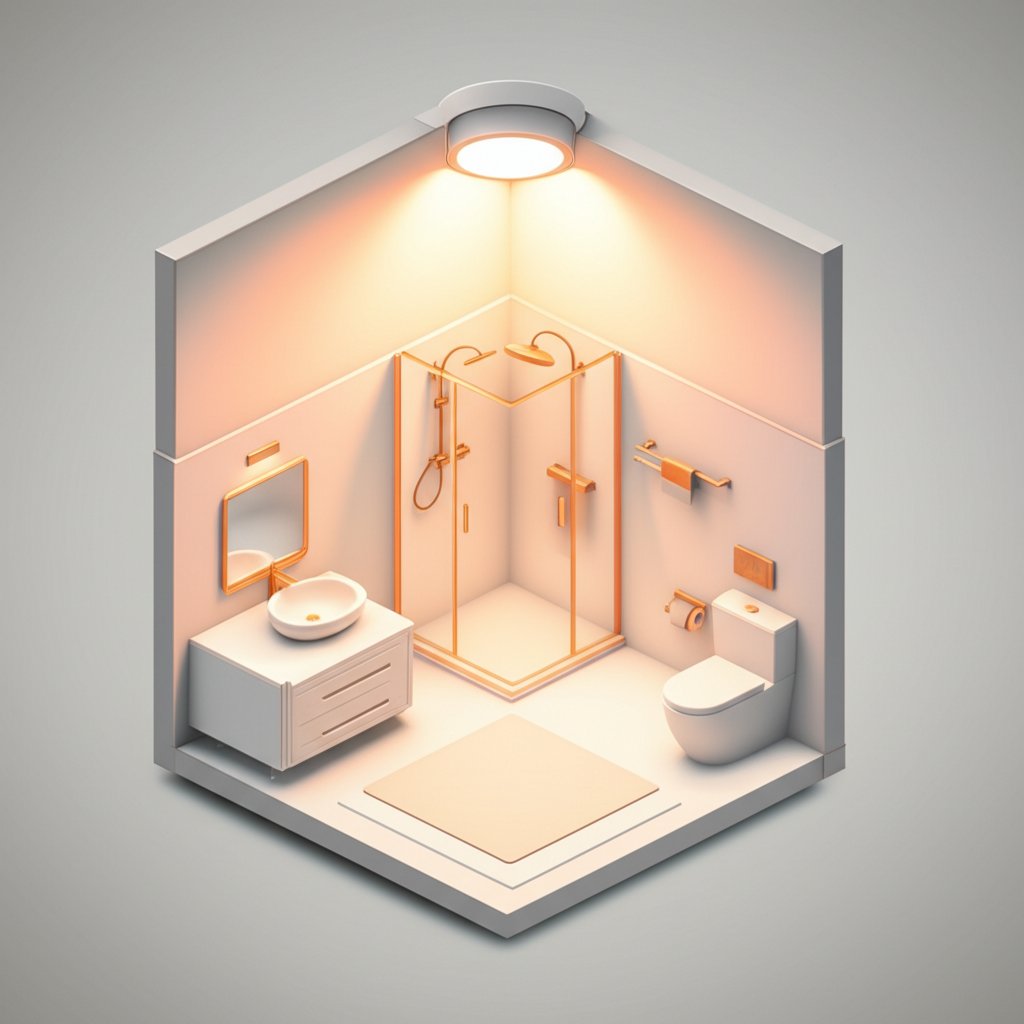
Flush mount bathroom lights solve this by design. Their low-profile construction provides three key advantages:
- Maximizes Headroom: They sit tight against the ceiling, eliminating the risk of someone tall bumping their head. This creates an open, uncluttered feeling, which is essential in small spaces.
- Provides Broad, Even Illumination: A centrally located flush mount is the perfect source of ambient light—the general, foundational layer of lighting that fills the entire room. It reduces harsh shadows, making the bathroom feel larger and more welcoming.
- Enhances Safety and Simplicity: With fewer exposed parts and a secure mounting, they are less likely to be damaged by moisture or accidental bumps. They are also significantly easier to clean than intricate fixtures, a major plus in a room that requires constant upkeep.
While a great flush mount handles the ambient lighting, a truly well-lit bathroom often uses a layered approach. This is where you might add task lighting (like sconces by the mirror) or accent lighting. For a complete overview of how to combine these sources, our guide to the Best small bathroom ceiling lights provides a foundational framework.
Decoding the Specs: What Really Matters for Your Bathroom
When you start shopping, you’ll be hit with a wall of technical terms: lumens, Kelvins, UL ratings. Let’s break down the few that are truly critical for making a smart choice.
Getting the Size and Scale Just Right
A fixture that’s too small will look lost and provide inadequate light, while one that’s too large can overwhelm the room.
A reliable interior design rule of thumb offers a simple formula:
Measure the length and width of your bathroom in feet. Add those two numbers together. The result is the ideal diameter for your light fixture in inches.
- Mini-Scenario: Your bathroom is 7 feet wide by 9 feet long.
- Calculation: 7 + 9 = 16.
- Result: You should look for a flush mount light that is approximately 16 inches in diameter.
Remember, this is a starting point. A sleek, modern LED panel with a slim profile will have less visual weight than a traditional fixture with a thick metal frame and bulky glass shade, even if they share the same diameter. Adjust based on the style and your personal preference.
Lumens, Not Watts: Measuring True Brightness
For decades, we were taught to judge a bulb’s brightness by its wattage. With the advent of hyper-efficient LEDs, that metric is obsolete. Today, the only number that matters for brightness is lumens.
The Illuminating Engineering Society (IES) provides guidelines for lighting different spaces. For bathrooms, they recommend a range of 50 to 100 foot-candles (a unit of light intensity), which translates to roughly 70-80 lumens per square foot for good ambient lighting.
Here’s a quick reference table to get you started:
| Bathroom Size (sq. ft.) | Typical Dimensions | Recommended Lumens | Example Product Match |
|---|---|---|---|
| Powder Room (Under 40) | 5′ x 6′ | 1,200 – 1,800 lumens | TOOWELL Motion Sensor (battery) or a single-bulb fixture. |
| Small Full Bath (40 – 75) | 7′ x 8′ | 1,500 – 2,500 lumens | Lepro 8.7 inch or similar 15W LED models (1500 lumens). |
| Medium/Master (75 – 120) | 9′ x 10′ | 2,400 – 4,000 lumens | SunRider 24W LED (2400 lumens) or a multi-bulb fixture. |
| Pro Tip: It’s always better to have slightly too many lumens and control them with a dimmer than to be stuck with a room that’s permanently too dark. |
The Damp vs. Wet Rating: A Non-Negotiable Safety Check
Water and electricity are a dangerous combination. That’s why lighting fixtures intended for bathrooms must carry a specific safety rating from a body like Underwriters Laboratories (UL). For bathrooms, you’ll encounter two primary ratings:
- UL Damp-Rated: This is the minimum requirement for any bathroom light fixture. It means the fixture is designed to withstand moisture and condensation but should not be in direct contact with water. This is suitable for the main ceiling light located outside of the shower or tub enclosure.
- UL Wet-Rated: This is required for any light installed inside a shower or directly over a bathtub where it could be sprayed with water. These fixtures are sealed and constructed to prevent water from reaching the internal wiring.
Never install a “dry-rated” fixture (meant for bedrooms or hallways) in a bathroom. The steam from a hot shower can cause it to short-circuit, rust, and become a serious safety hazard.
Setting the Mood: Color Temperature and Dimmers
The right brightness makes a room functional; the right color and control make it feel good.
From Clinical to Cozy: Choosing Your Color Temperature (CCT)
The color of white light is measured on the Kelvin (K) scale. Lower numbers are warmer (more yellow/orange), and higher numbers are cooler (more blue).
- 2700K (Warm White): Very cozy and inviting, similar to a traditional incandescent bulb. Great for a relaxing atmosphere but can cast a yellowish hue that isn’t ideal for applying makeup.
- 3000K (Soft White): A crisp, clean white light that’s still warm enough to be comfortable. A popular and versatile choice for bathrooms.
- 4000K (Cool White/Neutral): Mimics bright daylight. It’s excellent for task-oriented bathrooms where color accuracy is important (think makeup, shaving). It can feel a bit stark if it’s the only light source.
- 5000K+ (Daylight): A very bright, blue-toned light. Often used in commercial settings, it can feel clinical and harsh in a home bathroom.
For most people, a fixture between 3000K and 4000K hits the sweet spot. Many modern LED flush mount lights now come with an adjustable CCT switch, allowing you to select your preferred color temperature during installation. This feature, found in fixtures like the recommended 8PACK LED Flush Mount, offers incredible flexibility.
The Power of Dimmability
A dimmer switch is one of the most impactful, low-cost upgrades you can make in a bathroom. It allows you to have bright, task-oriented light when you’re getting ready in the morning and a soft, relaxing glow for an evening soak in the tub.
Crucial Caveat: Not all LED fixtures are dimmable, and not all dimmer switches are compatible with LEDs. To avoid flickering or humming, ensure the flush mount is explicitly labeled “dimmable” and pair it with a modern CL (CFL/LED) or ELV (Electronic Low Voltage) dimmer switch.
A Practical Guide to Styles and Materials

Functionality is key, but you don’t have to sacrifice style. Flush mount bathroom lights are available in a huge range of designs to match any decor.
Modern and Minimalist: The Rise of LED Panels
These fixtures are the definition of “less is more.” Often shaped as ultra-thin squares or circles, they provide a seamless, integrated look.
- Aesthetic: Clean lines, no visible bulbs, and a futuristic feel.
- Light Quality: They typically feature an edge-lit design with a diffuser, which produces a completely even, shadow-free sheet of light.
- Best For: Contemporary, minimalist, and Scandinavian-style bathrooms.
Transitional and Timeless: Updated Classic Designs
This is the most common category, blending traditional forms with modern finishes. Think of a classic round or square shape enclosed by a metal frame.
- Aesthetic: Versatile and familiar. Look for finishes like brushed nickel, matte black, or aged brass to coordinate with your faucets and hardware. The shade material also plays a big role—frosted glass softens light, while seeded glass (like that in the Industrial Semi Flush Mount option) adds a touch of texture and character.
- Best For: Almost any bathroom style, from traditional to modern farmhouse.
Smart and Feature-Rich: The New Wave of Bathroom Lighting
Technology has found its way into bathroom lighting, offering more than just illumination.
- Features: Look for models with built-in motion sensors that turn on automatically—perfect for kids or middle-of-the-night trips. Others include integrated Bluetooth speakers to stream music or podcasts. Some, like the Black Waterproof LED, even offer full RGB color-changing capabilities controlled by a remote or app.
- Best For: Homeowners who love tech, convenience, and a little bit of fun in their functional spaces.
Quick Answers to Common Flush Mount Questions
Can I install a flush mount light myself?
If you have experience with home electrical work and understand how to safely turn off power at the circuit breaker, you might be able to. However, due to the presence of moisture, hiring a licensed electrician is the safest and recommended approach. It ensures the fixture is wired correctly and securely sealed.
Are LED integrated flush mounts a good idea?
Absolutely. An integrated LED fixture means the light source is built directly into the unit. The primary benefit is an extremely long lifespan—often 25,000 to 50,000 hours, which can translate to over 20 years of normal use. The downside is that you can’t just replace a bulb; the entire fixture must be replaced. Given their longevity, this is a worthwhile trade-off for most people.
How do I clean my flush mount bathroom light?
First, always turn off the power at the breaker—not just the wall switch. For the exterior, a dry microfiber cloth is usually sufficient. For tougher grime, slightly dampen the cloth with water. For the glass or plastic diffuser, check the manufacturer’s instructions. Most can be gently twisted or unclipped for removal and cleaned with a mild soap and water solution. Ensure it’s completely dry before reassembling.
Why is my new LED flush mount humming or buzzing?
This is almost always due to an incompatibility with your dimmer switch. Older dimmer switches were designed for incandescent bulbs and can cause modern LEDs to buzz. The solution is to replace the switch with a modern dimmer rated for LEDs (often labeled as a C-L or ELV dimmer).
Your Decision-Making Checklist
Feeling ready? Use this quick checklist to guide your final choice.
- Measure Your Space: Confirm your ceiling height is under 9 feet. Use the length + width formula to determine your ideal diameter.
- Calculate Brightness: Multiply your bathroom’s square footage by 70 to get your target lumen count.
- Confirm Safety Rating: The fixture must be at least UL Damp-Rated.
- Pick Your Color: Choose a fixture in the 3000K to 4000K range for the best balance of ambiance and task clarity.
- Select Your Style: Match the finish and shape to your vanity hardware, faucet, and overall decor.
- Demand Dimmability: If it’s a full bathroom, insist on a dimmable fixture and pair it with a compatible LED dimmer for maximum flexibility.
A great flush mount bathroom light does more than just illuminate a room. It sets the tone for your daily rituals, from the bright, energetic start to your day to the calm, relaxing end. By focusing on the essentials—safety, size, and the quality of light—you’re not just buying a fixture; you’re investing in a brighter, more functional, and more beautiful space.

- Bathroom Materials Selection Offers Quality Fixtures for Home Design Projects - October 9, 2026
- Best Cosmetic Storage Containers For a Tidy Vanity - October 8, 2026
- Best Makeup Storage Boxes to Keep Your Vanity Spotless - October 7, 2026